

Everybody got a breaking point, kid
— Outro, Killing Me Softly With His Song, The Fugees
You may have had that dream where you want to move your limbs, or any part of your body, but found it impossible. That time, nothing strikes fear into your heart than the feeling of helplessness.
Many explanations abound. I grew up being told it was spirits who sat on top of you and watched as you struggled to move, much to their amusement. There is never a clear image of what this supposed malicious spirit looks like, but several artists have tried to give it form. It must be ugly. Horns poking from the side of its head, for instance. Despite it sitting on top of you, it is weightless, but you’re completely overpowered.
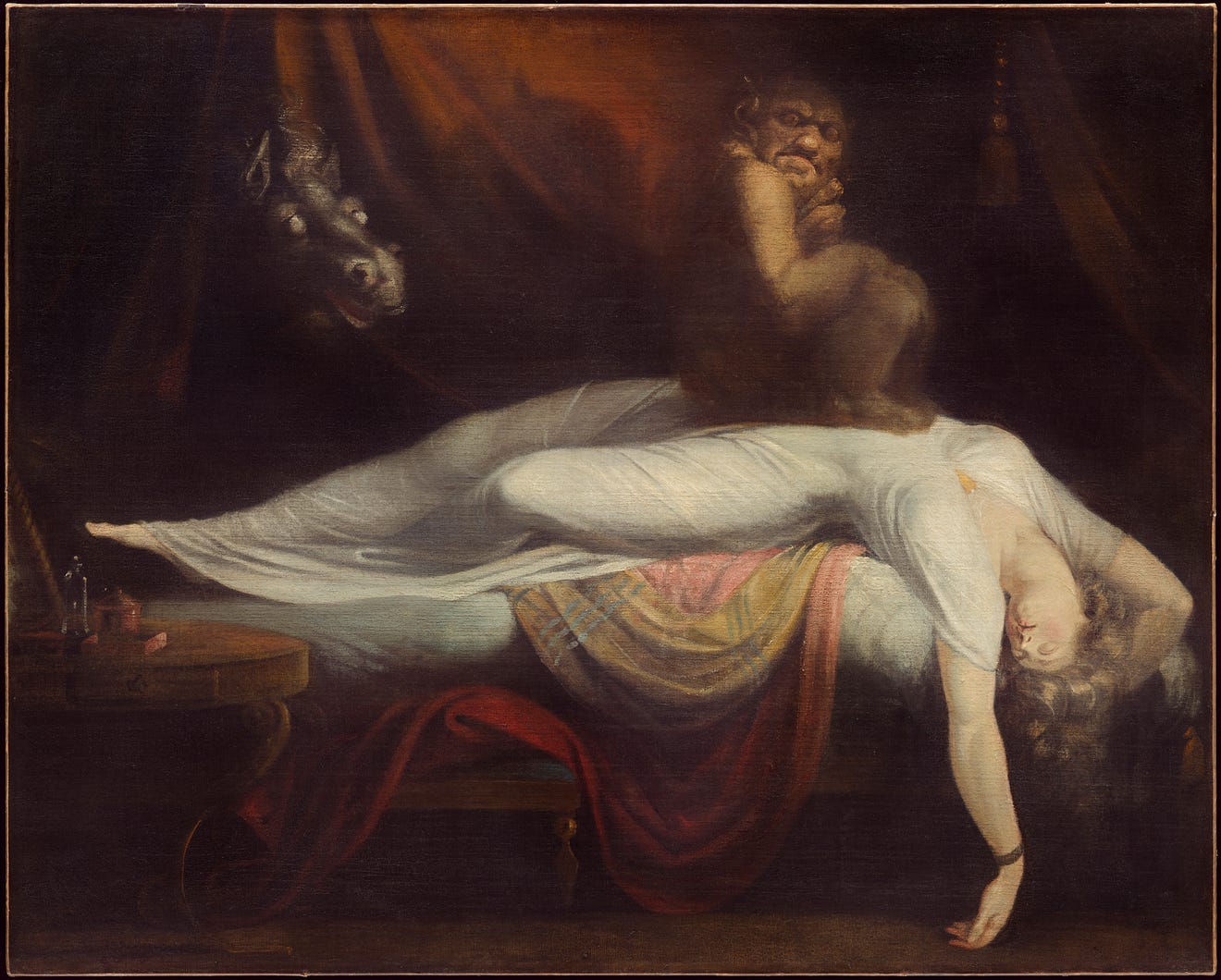
As powerful as the image may be, paralysis is protective. This is the time when you are actively living your dream, the rapid eye movement (REM) phase of sleep. At this brief interlude before you wake up, your brain does not distinguish between reality and dreamland. An EEG does not register differences in parts of your brain that usually light up when awake and the REM phase of sleep.
Paralysis, however, ensures you don’t enact your dreams. You don’t want to kick your partner while in bed, even though there are moments when some spouses would have wished that be the case. There are also breakthrough episodes when the paralysis is overcome, but these are one-offs.
Notably is the feeling one has after they have woken up from the fear-stricken moment. You may be sweating. You begin to survey your surroundings. The fear does not completely fade, but it abates. Going back to sleep immediately seems impossible, even though most times, we succeed.
Fear can have such a freezing effect. I want us to explore what could be the origins of freezing as a response. The catalyst is fear.
More than fight and flight
The typical response we have intuitively known in the event of danger is either fight or flight. When younger, it was fleeing. In an African home, the projectile that was a shoe or slipper could find you unprepared, achieving its intended effect, so fleeing was the first option.
And yet, most of our memories don’t crystallize until we have somewhat started going to school. Usually around 4–5 years old. Kids, however, were exposed to terrifying moments before this time.
Think about those sounds that frighten them. They have an immediate jerk and then freeze momentarily. And when they notice the frightening confusion has passed, say, when a familiar face forms, they revert to their usual response: crying. Once they have started crying, repeating the same sound no longer elicits rigidity. It’s now crying full-blown.
That’s the key insight. A fear that is palpable but indescribable. This is the first feature the toddler cannot make out. Evident, but without shape. Secondly, they can neither run nor fight. Even if it were a child as strong as Bamm-Bamm Rubble, how can you fight what you cannot see, observe, or comprehend? Paralysis ensues.
This fear is similar to the kind we have during sleep, when you want to move your hands or legs, but cannot. The fear is very much evident, but you cannot delineate its form. This fear comes especially when you’re paralyzed.
Mammals that display the response are opossums, mice, rabbits, and deer. Consider what goes on inside a deer’s brain when it sees headlights. We have no deer interpreters, but we have had an experience on the road where an oncoming car blinds your path. This is the closest I can think deer get when a car with its lights shining bright approaches it.
Deer have good night vision. Their acuity, however, is built for the dim light in forests, not the bright lights in the dead of the night. When a car approaches them, headlights on full blast, their ears remain perked. They don’t see what’s happening, but they can hear something approaching them. Fear kicks in. They don’t know what it is they are afraid of, but the fear is palpable. They are not certain where to run. Their first instinct is not to fight. And so, they freeze. It bears a striking resemblance to our state when asleep.
In the bush, in the presence of prey, some animals freeze. The option of running may be out of the question, as the predator could be faster. Fighting is not an option. So they freeze, usually because the predator tends to find their prey through movement. Others strongly mimic death.
The prey that survives will have the trait passed to the next generation. And that’s how the feature is seen in different species. It proved beneficial at some point in their ancestor’s lives.
A more interesting perspective is when you meet someone who completely knocks your socks off. What happens? Your eyes dilate. Your heart begins to beat fast. Sometimes, sweat starts trickling into hidden crevices. Before you is a human form you have never seen before, or one whose presence you cannot explain, describe, or understand, just like that fear you have when asleep but cannot move. And like the Black Panther before Nakia, you freeze.
You don’t notice you have been paralyzed until someone forcefully nudges you back into reality. You then behave awkwardly as you begin to re-orient yourself, much like the one who wakes up in a fit of fear, confused.
Crusades
I felt all flushed with fever
Embarrassed by the crowd
I felt he found my letters
Then read each one out loud
I prayed that he would finish
But he just kept right on— Lauryn Hill
I believe the same phenomenon reappears in massive gatherings, especially when religion is involved. Body paralysis has often been used as a signal that the preacher possessed spiritual powers, potent enough to strike members in the congregation into unconsciousness.
I think what usually happens is an extension of the paralysis seen in different groups of mammals. Humans may be no exception.
Let’s first establish what needs to happen before we experience paralysis:
1. The subject needs to be struck with immense fear.
2. This fear is very much present, but they cannot explain where it’s coming from, cannot articulate it, nor can they put a clear form of the source of this fear. All they know is that it is present.
3. They cannot fight or flee, in particular because the fear is without form.
Crusades are a unique form of human gathering, usually of believers. Most attendees gather because they wish to get the word of God or listen to a prophet, partly because they want salvation or feel closer to God.
Once inside a crowd, everyone is practically prevented from moving. You only move after the crusade is over. Thus, when the preacher begins to speak in tongues, rebuking evil acts, some individuals may begin to experience fear. Thus it begins.
This fear is without description. Spontaneous. It attacks without warning. The subject cannot articulate it, and they have no known means of seeking refuge. What’s more, they cannot know how to fight or flee from whatever they cannot describe. They are like that rabbit that has noticed danger, but doesn’t want to turn in case it triggers the predator. The fear can be so significant that it knocks the individual unconscious.
These may be people who have re-examined their lives and felt that the sermon attacks them. In front of everyone, they feel like they have been stripped bare, and everyone around them knows that it is them the preacher is referring to. This is a kind of fear that one cannot escape, but sits heavily on top of them, like that supposed creature when one is asleep. It is weightless, but the weight is felt. The fear turns into unconsciousness. In the words of Lauryn Hill, “Killing me softly with his words.”
Naturally, when overwhelmed with fear, the brain can switch off. It’s a protective mechanism. All the energy the body would have consumed when running or fighting doesn’t make economic sense, since you have no way of explaining the fear you have.
I have witnessed something similar at work. Before a patient passes on, we try to reach out to the families. Patient vitals can be worsening, and we usually forewarn the family and ask that they visit the facility when one of their own is still alive.
For the unlucky family members who come late, breaking the news, no matter how tactful you may wish to be, eventually strikes fear in them. They cannot describe it, nor can they demarcate its extent. It’s present, and sits atop the kin. Heavy-hearted, the metaphor tries to capture what we have always failed to explain. And after the news is delivered, some of them collapse.
We tend to have our conference rooms close by, with the security guard close, so that in case any of these events unfold, we can prevent further injury.
Now, back to crusades.
Once these individuals who have collapsed wake up, they survey their environment. They usually are confused but gain recollection of where they are and the events that preceded their collapse. Having survived the knock-out, they give testimonies for their conversion. This is a surefire way of averting the danger.
Before, they feared everyone would know their ills. They collapsed. They woke up and found everyone worried. They then killed the fear by yielding to the message and the religious dictates. Publicly, they confess that they are changed. Jubilation follows, a signal that they have been accepted despite their sinful past.
Usually, such confessions, made in public, reinforce a tendency not to backslide. Any such stance made in public is a bond. Leaders have to take their oath before their subjects. It’s a means of ensuring they honour what they say, as everyone around serves as a witness. For the conscious subject who has woken up after a paralysing fear, confessing to the public binds them and the people.
The story will be shared about the powerful deeds of the preacher. And they are not wrong. However, pinning it on some supernatural being may be the difficult part to defend. You can strike fear into someone without invoking some supernatural power. The idea of a supernatural force at play is necessary to make this fear amorphous, without clear description. It’s almost surgical in its approach.
The best way to do this is to have a voice that can indeed strike fear. A hoarse one, coupled with antics that should convey that an indescribable event is about to happen — this event will happen somewhere in the congregation, and the preacher is the portal. A perfect recipe for culling a crowd and keeping followers in check.
What I’m trying to say is…
Fear controls so much. And sometimes, when it’s too much, we lose control. It could explain some of the stories we have heard. It does not only show itself in humans, but also in other species outside the mammalian world.
This is an explanation I have tried to flesh out from behaviour, lest it be taken as fact. But it needs to be debunked before the alternative, such as supernatural forces, can be considered as superior explanations.
This song inspired some of the lines used in this article. Source — YouTube