

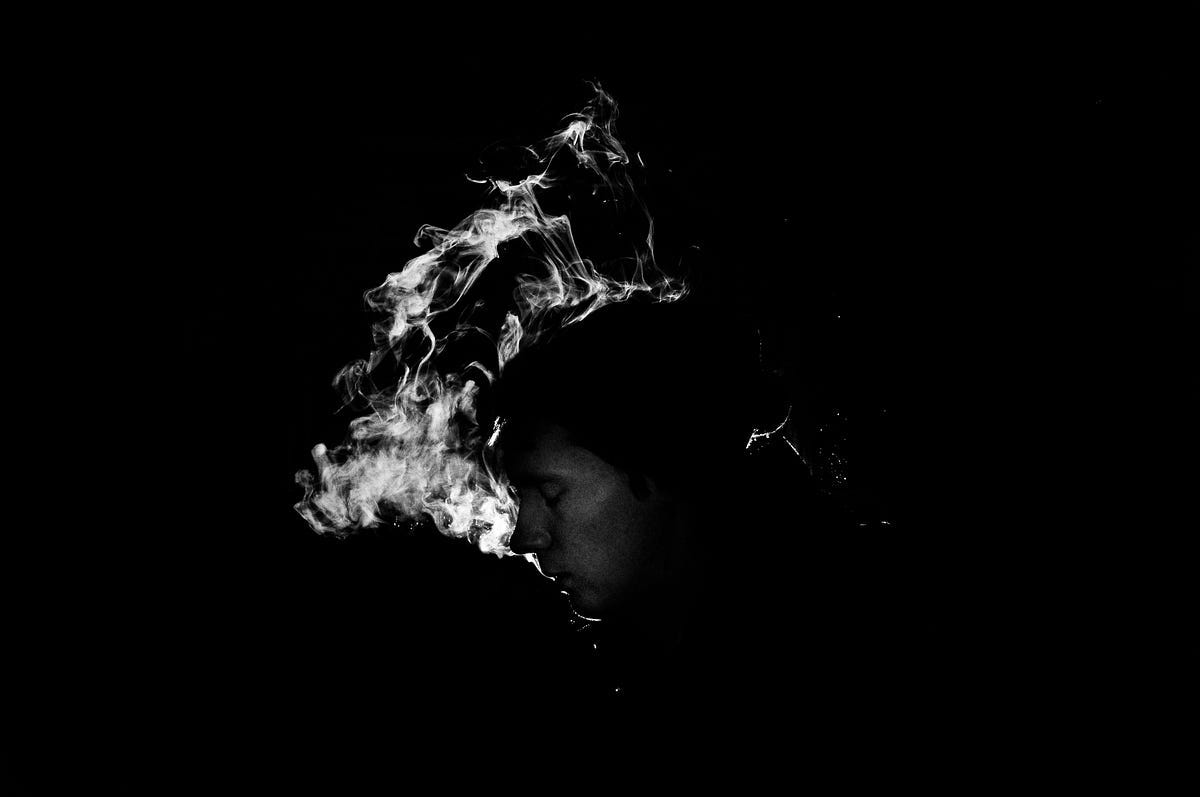
I don’t know just how it happened
I let down my guard
Swore I’d never fall in love again
But I fell hard
— Audra Mae
That’s how most, if not all, forms of addiction happen. Contemplation turns into a one-of trial. Subsequent trials change into conversations with oneself that only your demons are privy to. Before you know it, you’re hooked. This slippery road does not come with traffic lights.
Addiction has an evil tone to it, perhaps the only reason why your demons know the internal struggles you fight with occasionally. That’s the type of addiction studied in psychiatry classes. But what I think we gloss over is why addiction is so prevalent.
Do you know of anyone who has ever asked that question? Why does one get addicted to crack? Why, despite the countless dangers of such drugs, do we still encounter generations hooked on various substances? The opioid epidemic is another addiction that’s going rampant. I won’t even touch on our screen scrolling. These are the “negative” forms of addiction. But why do we get addicted in the first place?
A few similarities between food and drugs. Junkies can’t do without them. How different is it from our addiction to food? Like a junky, we get weak without food. Why are we addicted to oxygen? Without it, we literally die. The withdrawal symptoms of lack of oxygen are more fatal than those of alcohol. Once a substance becomes ingrained in our system, we hardly pause to think that we’re addicted to it.
Let’s borrow an olive branch from alcohol. One knows they are dependent if they cannot operate without it. A surgeon walks into an operating room and is handed a scalpel, and her fingers start to quiver. The team stands in silence as they observe the teacher who moulded every surgical resident in the hospital. A moment of weakness. She requests for a minute. She leaves, heads to the changing room, takes a few swigs of the good stuff, and is back, hands as steady as Samurai Jack’s.
Dependence makes you just that — dependent. Withdraw from the substance, and the dependence shows. Do you have an alternative to food? Do you have an alternative to oxygen? Do you have an alternative to crack? Or booze? For the latter examples, maybe. For the former ones, not quite. Still, the question stands — why do we still have addicts the world over?
I think the reason is we are addicts. Inherently, we become dependent by default. Others become too hooked to substances that worsen physiological outcomes, like cigarette smoking and alcohol intake. Evolution reveals that before some substances became inculcated into our regular physiology or habits, they were once poisonous.
Oxygen is poisonous. Too much of it kills. Yet, it was incorporated into our physiology. Respiration is a chemical burning process, much as a typical flame requires oxygen to burn. Who’s to say alcohol cannot be converted into a viable substrate? Don’t we already have the enzyme to convert it?
It took a while for unicellular organisms to harness the rising levels of oxygen into a substrate for their use. With an abundance of the gas, and thanks to mitochondria, more organisms proliferated to occupy Vernadsky’s space.
Eventually, most of the multicellular organisms became addicted. They could not do without it. Withdrawal symptoms became significantly associated with death. What was once harmful became useful. In the right doses. Indeed:
Guess I should have seen it coming
Caught me by surprise
Wasn’t looking where I was going
I fell into your eyes
We’re all addicts. The question a toddler will ask, much to the chagrin of most adults, is: Why?
Irritation is infinite
I believe we are all addicts because irritation is infinite. Irritation is infinite because ignorance is infinite. Intelligence, however, is finite.
Whatever forms of intelligence we invent, develop, or nurture will always be orders of magnitude smaller than ignorance. And in our infinite ignorance, we’re all equal. By the same token, in our infinite irritation, we’re all equal.
Irritation comes to the fore when picking which of our substrates we would like to convert from a harmful drug to a useful one. Drugs keep you going back for more. And one of the commonest drugs is our work lives.
Humans prime each other to prepare for a future where they have to grind to make do every day. And if you think that only applies to the working class, you’re wrong. The social media platform owners and tech oligarchs are addicted to the addicted users. Take away the online users and see how they wilt into withdrawal. Eliminate the salary of the everyday worker and observe the same. Humans consistently prepare one another for addiction.
Work is the kind of addiction you may hate but have to do. Think about the CAGE questionnaire. It’s the simple test used to measure alcohol dependence. The first one, “C,” asks: Have you ever contemplated cutting down on alcohol? Now, let’s switch to work. Cutting down is no less than stopping or developing a means to reduce and eventually cease taking the substance completely. Now, have you ever contemplated “cutting down” work? I’m guessing the answer for most of those reading this, like me, is a resounding “yes.”
The next question, “A,” tackles annoyance. Have people annoyed you by criticizing your alcohol intake? Switch it with work, and have people ever done the same? I can bet all humans have had such an encounter. Even within professions, it can linger. Among doctors, there’s a small, frivolous banter between colleagues that can at times irritate. Physicians call surgeons carpenters. Surgeons call physicians bedside debaters. So the answer to this question is yes.
You only need to answer two of these questions positively to warrant serious concern from a doctor.
But let’s continue.
The next one, “G,” stands for guilt. Not everyone feels guilty for the work they do. But there are also others who do. The final one, “E,” is for eye-opener. For five out of seven days, eye-openers are the reason we set morning alarms. Moments when you mistake your alarm for a calculator can, as we used to say in high school, put you in zou!
We could tentatively conclude that we’re addicts. The ultimate test of an addict is withdrawal. This has a multitude of effects. Since we’re used to associating illicit and hard substances with the kind we wish never to be addicted to, withdrawal can elicit disease. Alcohol withdrawal can cause delirium tremens, its most severe form. But walking away from some jobs can be liberating. Nevertheless, there are still similarities.
The thought of quitting alcohol can be so strong that the first few hours or days feel great, just as it does when leaving a toxic work environment. Then reality hits — you have no means of paying the bills. The withdrawal effects start to kick in. Frustration can push individuals to perform acts they never thought resided in their moral fibre, just so they can take care of their families or loved ones.
Perhaps the greatest manifestation of addiction is seen in retirement. The leading cause of death is age. With old age, other diseases kick in. Non-communicable diseases are a leading cause. Everybody gets different levels of neoplasia, which are the initial stages of cancer formation, even though they might not evolve into full-blown cancer. Hypertension develops in everyone with every decade after hitting adulthood. Strokes and cardiac arrests are typically more common in adults than in children. But after retirement, what I feel triggers these non-communicable diseases and eventual fatal outcomes is our addiction to work.
Once you stop working, you notice just how addicted you were to it. Rappers don’t like to be forgotten. Retirees would like to share their heydays with youngsters. Seasoned investors like to point out the fallacies of the noobs, rookies, and amateurs. Although the idea of fleeing from work early sounds appealing, at some point, you begin to ask yourself: What should I do with all this free time?
The idea is irritation. We are sent to school because our parents or guardians are irritated with the concept of you staying home without some layer of security or with the anxious feeling that you will fall behind your peers in the future. Presently, the problem is not honouring the right to education. Children then go to school.
It doesn’t look like irritation because it has been institutionalized. The ones who notice how education can be irritating are the homeschoolers. What subjects to start with, how to measure progress, how to socialize the kids. These questions can be irritating. The easy solution to avoid this irritation is to do what the masses do — send children to school.
As you grow older, you get to choose what to be irritated with. Consider parents. A mother’s first irritation, when in labour, is how to give birth quickly. Thanks to present-day technology, they choose either to have a CS or push vaginally. Expectant mothers never had such luxuries in the past, but our advancement in the health industry testifies to the willingness of mothers to make such decisions.
Moreover, the physiology of a mother changes significantly to feed the child, then, in a brief instant, it has to let go. If you have ever been to a labour ward, you will know what irritates the mothers at that point. It’s getting the baby out safely (for most) and finding a solution to the pain that just doesn’t let go. Once they have dealt with that irritation, it gradually becomes the incessant noise that accompanies the once-upon-a-time silent nights. Then the breastmilk. Or the baby fat. Or the persistent infections. Or the colic. Or the diaper rash. The irritations are a dime a dozen.
It’s either the adults choose to focus on these irritations, or they get a nanny. Getting a nanny is the equivalent of sending children to school. Institutionalized. Adults choose the kind of irritation they would like.
Should I hit the gym or take that infamous drug originally meant for patients with diabetes? The gym has its own form of addiction, as does the drug. We choose which pebbles to fit inside our shoes.
Enter work. As Adam Mastroianni brilliantly explained, you cannot love your work if you are not irritated by it. I know how this feels. I work in the ICU. The days I loathe the most are the ones when I walk into the unit and there’s a patient who has arrested. You quickly join the team, trying to resuscitate a life. It could go two ways. Life or death. Resuscitation, especially of a patient who has not been intubated, typically can take one to three hours to achieve some form of stability. The team needs to get consent from the family to proceed with these life-saving interventions. Emergency action requires the team to act according to the Hippocratic Oath. And after the movie, you have to call the family to update them on the interventions you needed to do. Then comes the wave of consultants who want to know about their patients, the same patients you have not reviewed because you needed to save the life of a single one. By the time you have somewhat settled down, the families need you to give them updates. In the evening, you only wish to leave. But as I head back home, I walk with a spring in my step. I had a good day, as annoying as it may sometimes be.
Choosing your passion is choosing what to be annoyed with. Picking your problems. Richard Hamming’s famous talk centres on the problems one should always be thinking of solving. These are the kind of problems that end up being addictions.
I recall times when I became so irritated with the idea of suicide, tossing and turning in my sleep, because suicide needed to make sense in terms of evolution. But once I found a suitable solution, I felt like I could walk the entire day, greeting everyone I met along the way. The solution was preceded by a great deal of irritation.
On top of that, I struggled for years to know how best to structure my first citable article on evolution. I had the whole concept, but I struggled with structuring the paper. What’s more, I didn’t know if it would be accepted since evolutionary biology was not my area of specialization. A few days ago, the article went up. This was after a great deal of irritation. Now I’m hooked, addicted. I want to publish more.
Irritation, which mirrors ignorance, is infinite. Choosing what irritates us is not just admitting our ignorance, but it also includes choosing which path to navigate in that hyperdimensional space of ignorance. I doubt you will ever encounter a human being who says they enjoy the work they do and is not irritated by it. That gives way to addiction. For sure:
You came into my crazy world
Like a cool and cleansing wave
Before I, I knew what hit me, baby
You were flowing through my veins
Choosing your problems
Now, think about your loved ones. Audra Mae summarises it:
I’m addicted to you
Hooked on your love
Like a powerful drug
I can’t get enough ofLost in your eyes
Drowning in blue
Out of control
What can I do
I’m addicted to you
You choose who to love, but they might not line up like applicants before an interview. It is never anticipated. And once you’re hooked, you can’t easily let go. Yes, there can be alternatives, but it comes after a great deal of suffering. Rebounds and chasing bottles and sniffing lines. Tumbling from one addiction to the next.
The irritation is not in one dimension. That person you love will be the cause of ineffably painful moments. Domestic violence can emerge. Sometimes, it is the need for a child or the costs and challenges of raising one. You will be irritated if you don’t know the whereabouts of the other, without prior communication, if the love is still alive. If not, nobody cares.
And after that breakup, that gut-wrenching heartbreak, your body will contort in withdrawal. Before the addiction wears off, your brain and body will take a good beating. It is an irritation. It’s infinite. It’s never discussed in psychiatric lectures. Yet, it is very real.
It can even be fatal. Ask Thelma & Louise who would have rather died with each other than be separated behind bars. Or Bonnie and Clyde. This is the kind of irritating addiction that makes a stone-cold gangster like 50 Cent ask 21 questions to a lady he loves.
Adults choose their problems, and by this measure, implicitly choose what irritates them. Since life is all problem-solving, with our finite knowledge, we get infinitely irritated because our capabilities can never match our inefficiencies. Getting a moment’s respite from all the problems, a puff, a sniff, a pint, a partner, a workplace, a house, a car, a watch, all these can hook us into addiction as a means to sidestep life’s inevitable irritation.
What I’m trying to say is…
Addiction is prevalent because it was evolutionarily primed in us by life’s penchant for seeking certainty and finding solutions to problems.
Our knowledge is finite, battling against infinite problems. In our ignorance, we become unintentionally irritated. Addiction is not just present in those held inside rehabilitation centres. It’s everywhere.
And as our previous addictions have shown, some can become useful. Oxygen changed from poison to fuel. Mitochondria changed from prey to life-giving organelles. Shelters became bastions for eusociality. Addiction seems inevitable.
So when Audra Mae asks what she can do, we should understand.
This song inspired some of the lines used in this article. Source — YouTube