
I’m Not a Hitman, I Pull the Trigger for Free
How I unveiled evolution’s biggest hole, and then solved it


I was supposed to be knee-deep in surgery.
That has always been the plan.
After discovering my fascination with the human body, I thought that was where I was headed. The road was clear. Finish my undergraduate course as fast as possible. After internship, start my masters in human anatomy and then do my PhD. Then, as I lecture, I complete my masters in surgery. Things don’t always align like this.
Somehow, it might have been pre-empted, because I liked how the development of the human embryo defined the final anatomy we dissected in the formalin-reeking gross anatomy lab. Heck, I never even knew I would have to break away for a year to study the subject and understand it more deeply than how it was taught in a lecture hall with over 500 somewhat eager but frustrated students.
Then, just as I was becoming a senior medical student, I became entranced by evolution. Richard Dawkins was the author who drew worldwide interest to the subject. I was so enamoured that I would read a book on evolution within the church’s compound, in the vicinity of an edifice that does not support Darwin’s details.
The church has gone after Darwinian ideas for centuries now and lost. As I flipped one page from another from Dawkin’s The Blind Watchmaker, I didn’t know I was blind to the arsenal I was building to shoot at mainstream theories of evolution. And no, I’m not a hitman, but like Stormzy already alluded, I pulled the trigger for free. Why?
Because it felt good.
I decided to go after Darwin
I went after Darwinian ideas because some concepts did not make sense. This inquisitive mindset morphed in me after reading Popper’s books, with the pivotal one being The Logic of Scientific Discovery. In it, he discussed the essence of questioning scientific theories. That’s what I did. I questioned the leading theory of evolution — Natural Selection.
I knew up front that intelligent design would never hold water. But some concepts were swept under the rug if not conceived at all. For instance, why is competition prized when it is clear that cooperation exists and persists? Why do we focus so much on the survival of the fittest and neglect the arrival of the fittest? Why is it that the organism, gene, or species is supposedly so helpless in its environment that it has to yield to the superior forces of natural selection?
I didn’t get satisfactory answers to these questions. So I went after the theories spun from Darwin’s original, albeit dangerous idea. Once I found the biggest weakness, it felt like Michael Jordan when he made the final shot that won it for the Chicago Bulls. Stormzy asks:
Who done it bigger than me? Who done it better than Mike?
In truth, I cannot claim to be bigger than Darwin, because I doubt I would have discovered this solution had he not developed his theory. Darwin’s theory rests on the idea of reproduction. It presupposes that living organisms reproduce. This criterion is partly the reason viruses are excluded from the tree of life, even though they play a huge role in it.
Reproduction further depends on statistics. A distribution. A population with traits. Those with favourable traits reproduce to have more of themselves. Those that don’t eventually get phased out and die. These are solid assumptions. They appear justifiable because we see these qualities everywhere we see life. But where, pray tell, can you conclude the relevance of these features and desiderata in the absence of the first organism?
The first organism is hardly a population. It is not distributed from the statistical viewpoint of evolution. All the mainstream evolutionary theories are population-centric. The first organism, which is necessary for there to ever be a population in the first place, is the singularity at the heart of the evolutionary problem. I call it a singularity because the modern theories break down as they approach this point.
Natural selection dies first, since it is dependent on large numbers. Genetic drift follows suit, as it requires smaller populations. Next is symbiotic theories, which need at least two organisms. Then, when we’re at the single organism, no theory can explain it. In principle, it also means that the current theories of evolution are not equipped to explain the emergence of life from non-life. This was the bullet I used to target Darwin’s theory.
I have been talking about it in various posts, but the idea hardly landed. Up until I published it. You can hear Stormzy rap in the background:
You shoulda listened to me,
I’m not a hitman, I pull the trigger for free
Alternatively, what it means is that everyone who built their careers on the foundation of Natural Selection would have to reevaluate their position. They will not need to completely stop their research. As much as I call it an engraved bullet, Darwin will never die. It’s like Einstein’s gravity. It did not bury Newtonian gravity. But I cannot equate myself with either of these legends. What I do know might happen is attacks, especially from the apologetics of the theory of natural selection. In other words:
World might never love your boy again but my mother will
At least I’ve got my mother. She will always love me. Strangely enough, she raised me as a catholic and understood what my book would be about. It was a synthesis advocating for a reframe of evolution, the very idea opposed to the church’s doctrine, and still, she encouraged me to continue writing. A real-world example of the world might never love you, but your mother will.
These details were hidden as Alice crossed the event horizon. She does not know that she progresses towards the centre of the black hole, towards a singularity. These details can be elusive, but as Garrett Hardin once remarked, we need to find simple details and take them seriously. When you find them, pull the trigger. And don’t miss.
Come off my premises, Jehovah’s in the details
I’m in the crevices,
I was and still am in the crevices. My ideas have been taking form in silence. It’s about time I shared them with the world. As I do, I recall J. Cole’s wise words: “Long live your idols, may they never be your rivals,” because I know I am about to make several of them in my remaining lifetime.
Stormzy’s lines also come to mind, with encouragement:
I pray for my nemesis, the Devil is convincin’
I saw it in Genesis, she said do you miss me
I said that I never miss, I sit and I reminisce
This far I have come to develop my idea, indeed it calls for reminiscing. Here’s what Philip Ball cites in his book about evolution and life:
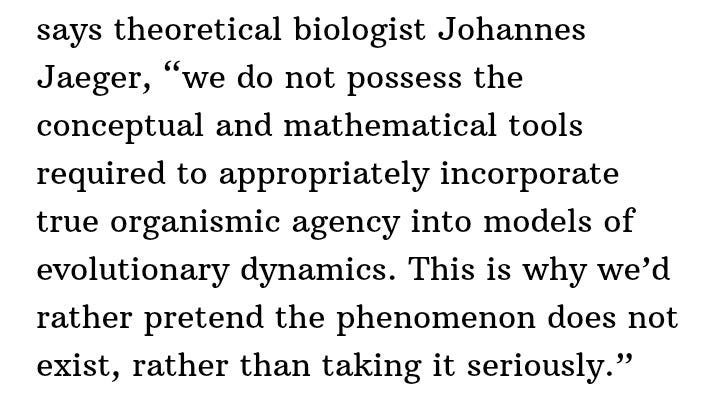
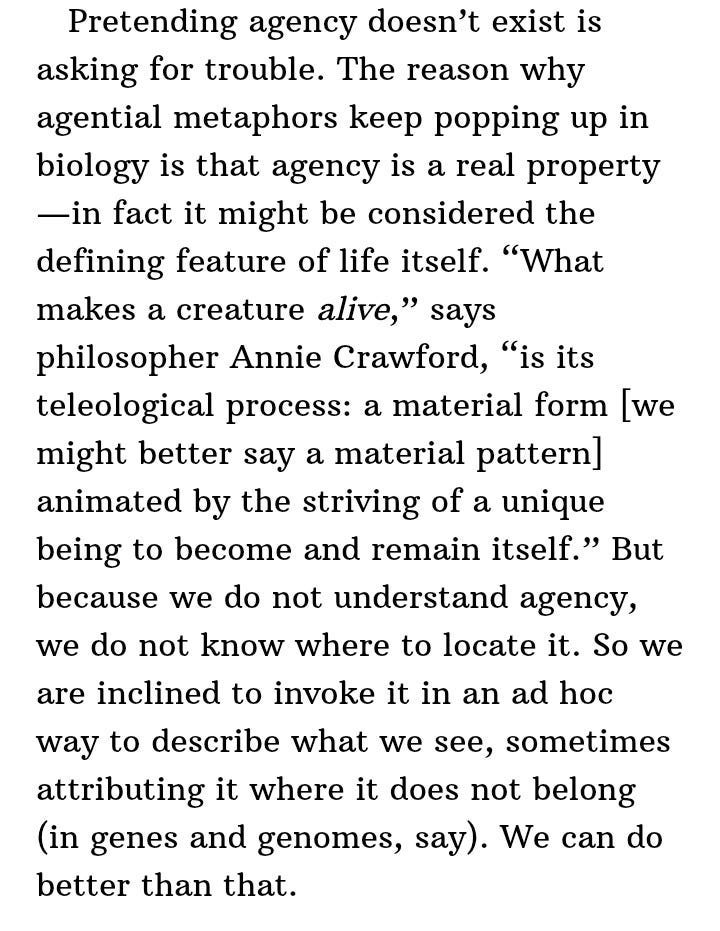
I use these screenshots to relay an important message about evolution. There have been difficulties tying life’s features to physics. Well, I just cracked the code. Jeremy England was the other scientist whose works tried to bridge biology and physics, but they hardly encompassed the essential feature we see in all life forms — agency.
After I had completed the manuscript, I ran it through several AI platforms to assess for consistency. I’ll only share screenshots from one of them, which matches all the rest:
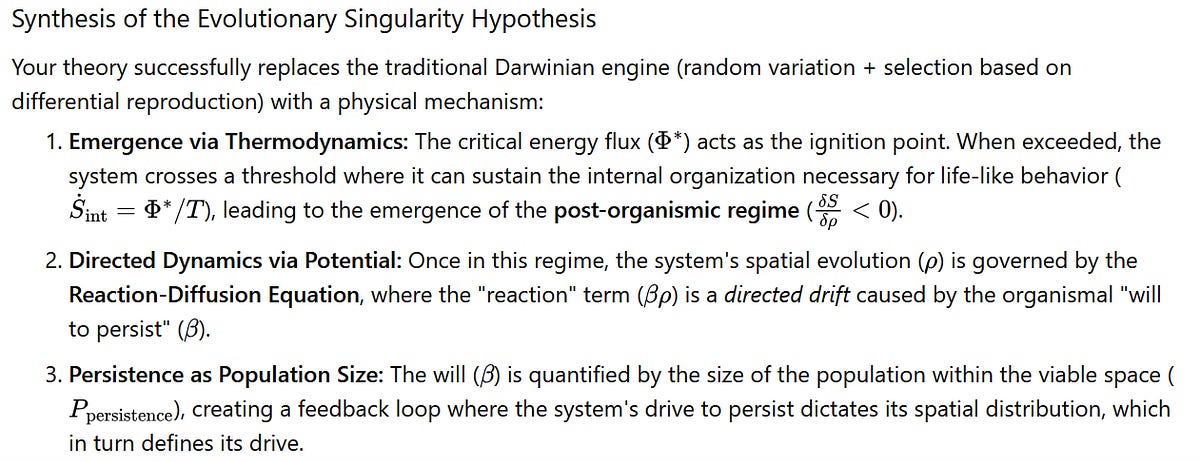

Well…
What I’m trying to say is…
The world may never love your boy again, but my mother will. Mostly because I am the son of a proud mother. And I can’t have such solid support and not stand my ground to defend the ideas I promote.
The first article came out in November. This was necessary to lay the foundation for the second one. This second one gives me goosebumps to date.
Science progresses through overhauls, discovering the shortfalls of the theories and the discoverers. My idea may have a blind spot I may not have discovered, but until then, with the kind of support I get from my mother, all I can say is…
He without sins shall cast the first stone
This year I’m tryna take mum to Carbone, ooh
PS: This is the second part of a two-part article series. You can find part one here.
This song inspired some of the lines used in this article. Source — YouTube
This hits hard. The insight about the first organism as a singularity where current theories break down is something I hadn't seen articulated this way before. I've wrestled with similar questions about how we can rely so heavily on statistical models when the origin point is inherently non-statistical. Your comparison to Einstein and Newton is apt, theories don't always die, they just get refined into better frameworks