

Numbers is hard and real, and they never have feelings
But you push too hard, even numbers got limits
— Yasiin Bey
I became fascinated by IQ tests in high school.
While washing our clothes one Saturday morning, my classmates began discussing it, and individual figures were shared, which made little sense to me, who had never heard about them until that point. So, I planned to check them out once I went back home, as the boarding school I attended did not afford some of us the luxury of browsing the internet. Heck, I didn’t even know how to set up an email by then.
During the April holidays, after visiting a nearby cyber cafe, I found some tests. They gave the ranges of what they considered above average, moronic, genius, and, if my memory serves me correctly, savant. Einstein, the popular name associated with genius, had his figure up there with the cirrus clouds. Confident in my cognitive ability, I did the test. Let’s just say, it wasn’t bad. But I didn’t feel I qualified to fit in the category they placed me in. There was nothing celebratory about my life. For that reason, I remained skeptical.
So I did another test. The results were different. My skepticism grew. I only needed those two tests to never believe in the results IQ tests produced. But my argument was weak.
For instance, how could I tell if the tests were standard? Were they prepared for someone like me, who barely knew how to set up an email? These could have been easily answered. The more important questions came later, decades later, because when you think about it, Einstein never sat for an IQ test. Neither did Darwin nor Newton. How did these websites arrive at such numbers?
Knowing how the internet operates, hindsight reflection points us towards business. It’s all business for most of these websites. One website lists Isaac Newton’s IQ as 190–200, while another reports it as 190–220. The latter website is likely to be fiddling with numbers, given a variance as significant as 30 points. When you visit the website, you’ll be shocked that they give Nikola Tesla an IQ range of 130–310. A whole IQ score serves as the variance. As you continue scrolling, the website throws an ad for you to upgrade your memory using their memory app. It’s all business.
Nevertheless, IQ is pretty predictive.
The predictive qualities of IQ
Steven Hawking had a brilliant mind. You would guess that he had a high IQ. And yet, this is what he had to say about the tests:
I have no idea. People who boast about their IQ are losers.
That’s the first predictive quality. Not that I mean anyone who took the test is a loser, because I would fall in that category. More than once.
An IQ test can predict that the person who took the test was a human. Other animals can’t take the test. It’s pretty predictive. Now with bots circulating the internet, the test has lost some other predictive value in this regard. We are, however, looking at a life before AI and bots. Let’s stick to that.
The tests also predict that the person had hands. And a brain. They were alive and received an education. They could write, or if not, at least read. They received a basic education at the worst, and they could focus on a test from its beginning to its end. That’s pretty predictive, but that’s where it largely ends.
Intelligence, as I have come to understand it, is multidimensional. Fitting it to a scale and assuming that everyone will rank somewhere on it is snake oil. It does sell. Most people would want to know where they fit, including my past self. Humans love to associate themselves with greatness. It’s easy to find a means to establish just how far apart one was from a household genius.
But some questions you should ask yourself before indulging the person who made the test are: why is it that these historic figures have stratospherically high IQs? Why do they always end with 0 or 5? Why is it that when we take the test, our figures are fixed on a single number while theirs are ranges? Assuming those who range between 145 and 159 are above average intelligence, and those above 160 are geniuses, does this mean that the difference between a genius and an above-average intelligent individual is one point? Does that make sense?
Once we question the numbers, the paradigm starts to crumple. Einstein is often used as an example of what genius is, but the leading experts in mathematics and game theory will tell you that Von Neumann was miles more erudite than Einstein. However, not many people know about Neumann. They know about Einstein. For your business model to thrive, it’s better to use Einstein than Neumann.
Some surrogate markers exist, based on evidence from the West. I doubt we have such studies in our continent. Hoel writes:
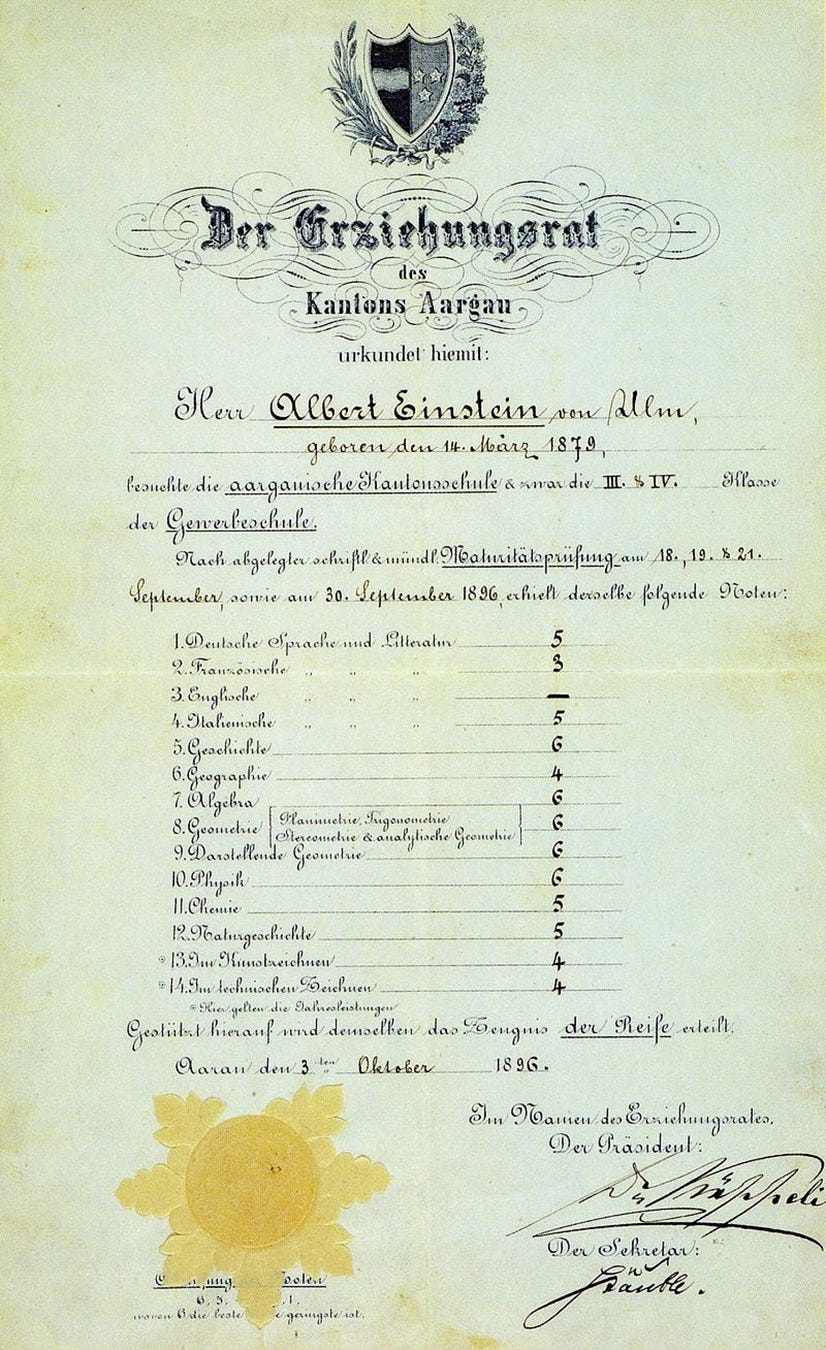
What about Einstein’s grades? Current evidence tells us that grades are “strongly positively correlated” with IQ. If someone gets very high grades, we’d expect them to score high on an IQ test. And while there certainly may be differences between now and then, Einstein was not getting top grades. Here’s his high school report card, with grades spanning from 1–6 (not all sixes):

Can genius be captured in a scale?
Brilliance in tests does not necessarily equate to genius-level intellect. The distinction between book smart and street smart is one way to look at it, but not the only way. The question we need to ask ourselves is what defines genius?
The answer reveals that geniuses are the ones who have contributed significantly in various fields with their ideas. New ideas either displace the preceding paradigms or diverge from their previous directions (for instance, in terms of predictions). The ideas are generally unpredictable from the previously held concepts. And their success, which comes later, is then acknowledged as genius. It’s all in retrospect.
Einstein’s theories of relativity took over a decade before they were globally accepted. Darwin’s concept of natural selection was almost buried before its resuscitation by Sewall Wright, J.B.S. Haldane, and Ronald Fisher. Peter D. Mitchel’s insights into the mechanism of the mitochondria were intensely refuted until decades later, when the scientific caucus agreed that he was right all along. Lorentz, so we’re told, committed suicide because nobody gave a serious thought about his statistical translation of thermodynamics.
From history, genius is a cognitive quality bequeathed in retrospect. And yet, we’re supposed to take a test to know up front where we rank on that scale. IQ tests are not predictive of genius-level intellect, only that a human took the test.
One cannot tell a priori how their ideas will shape the future. For the most part, the generators of the ideas don’t get to say how they will impact humanity. Einstein’s equations were used to build the atomic bomb. Feynman’s quantum electrodynamics has shifted our night world in ways he never could have imagined. Our understanding of RNAs has been harnessed to create vaccines. The genius degrees of contribution cannot be known up front, let alone from a scale that is marred by various underdiscussed qualities, especially at the top.
The errors as you climb
The lower side or tail of the IQ scale is mostly untouched. That one should think of doing an IQ test, unlike Hawkin’s response, means that you think you’re not a loser. You often want to see the scope of your intellect. Sadly, the IQ range does these individuals a disservice, because it can either puff you up or confine you to thinking that you’re set in a certain range. You’re not.
Firstly, IQ tests, like any other tests, can be hacked. The more you do SATs and revise them, the better you become. The more you do IQ tests, the higher you will score. IQ tests are not static, just like intelligence. And what we should bear in mind is that we cannot know the full scope of intelligence to capture it in a scale. That should tell you the second most important thing — there are errors when you climb up the IQ scale.
By errors, I mean it becomes difficult to estimate just how intelligent someone is by using a preset figure. The standard error of the mean (SEM) shoots as you move towards the tail ends of the IQ scale. The lower tail hardly interests anyone. The upper one is where everyone centres. But this side has a huge variance, such that it is less predictive of one’s intelligence and meaningless to make a range as huge as 30 basis points. That website I shared ignores such realities about distributions. Outliers and extreme outliers sit in a range that is difficult to scale or compare using an ordinal scale.
Using historic figures and arbitrarily giving them a number is lazy at best and exploitative at worst. The very people would question the intentions of anyone wishing to position them on a line.
As an extension of the idea of what we think is genius, we forget that the same people had other intellectual qualities we may not necessarily link with high intellectual acumen. Newton formulated the laws of motion and cofounded calculus, but he was just as interested in alchemy, the mythological practice of converting metals into gold. Had Newton hidden his mathematical findings and prioritized discussing his ideas on alchemy, would he have ranked as high as many think he would?
What’s more is that the historic figures are a very small sample to use. Small numbers tend to create significant variance. It’s not enough for us to simply assign the geniuses a number and think every other genius will fall somewhere around that range. In short, stratospheric IQs don’t exist.
What does is curiosity, a drive to find nature’s biggest secrets and the thrill of such discoveries. And curiosity cannot be captured, yet again, by a scale. Neither can you confine passion and drive. These were the qualities of the founders of the biggest ideas we celebrate, and which define human advancements.
What I’m trying to say is…
The astronomically high IQ levels don’t exist. They are numbers someone somewhere thought should affix to figures we continue to laud.
IQ tests can also be predictive, but not so much about intelligence. They can predict that someone is above average intelligence and that they will hardly fail at school. They can predict that someone went to school in the first place. But they do not predict the geniuses and savants.
It’s all mathematics.
This song inspired some of the lines used in this article. Source — YouTube