

Kick, push, kick, push; coast
And away he rolled
Just a rebel to the world with no place to go
— Lupe Fiasco
Our minds like proportionality.
When we think about growth, there must be an upward trend. A trend implies at least two points. The more points, the better. In a line graph, all points project upward. Growth.
In a city, the number of patents, job opportunities, building structures, immigration, diseases, mushrooming shanties, birth rates — all are shown to grow if they point upward. Nothing remarkable in that.
Nevertheless, we can divide growth into grades of interestingness. For companies, developers, crime syndicates, the goal is to achieve the least interesting form of growth. A customer growth from 100 this month to 120 next month; completion of two floors by the end of the month by a construction company; recruitment of more drug dealers to increase the reach. Growth in simple ways. This is the least interesting, but the most sought-after.
Anyone with a basic form of education understands this type of growth. It’s why it is the least interesting. Not to belittle it, but the interesting bits of knowledge often attract the smallest percentage of people. I will call this type of growth the upward slope.
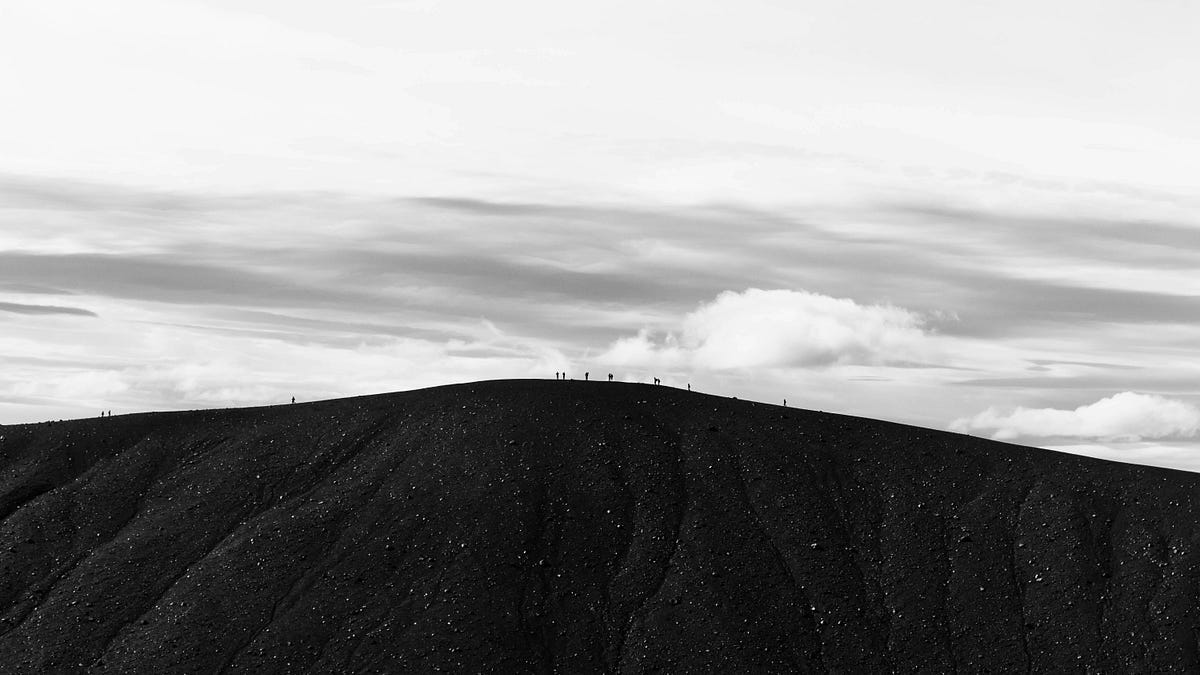
The upward slope looks like a mountain. In economics, the mountain can be rugged, especially when one zooms in on the interval time points. As one zooms out, they turn smoother. An upward slope does not have to have the Mt. Fuji form. Provided there is an upward trajectory, everyone is happy.
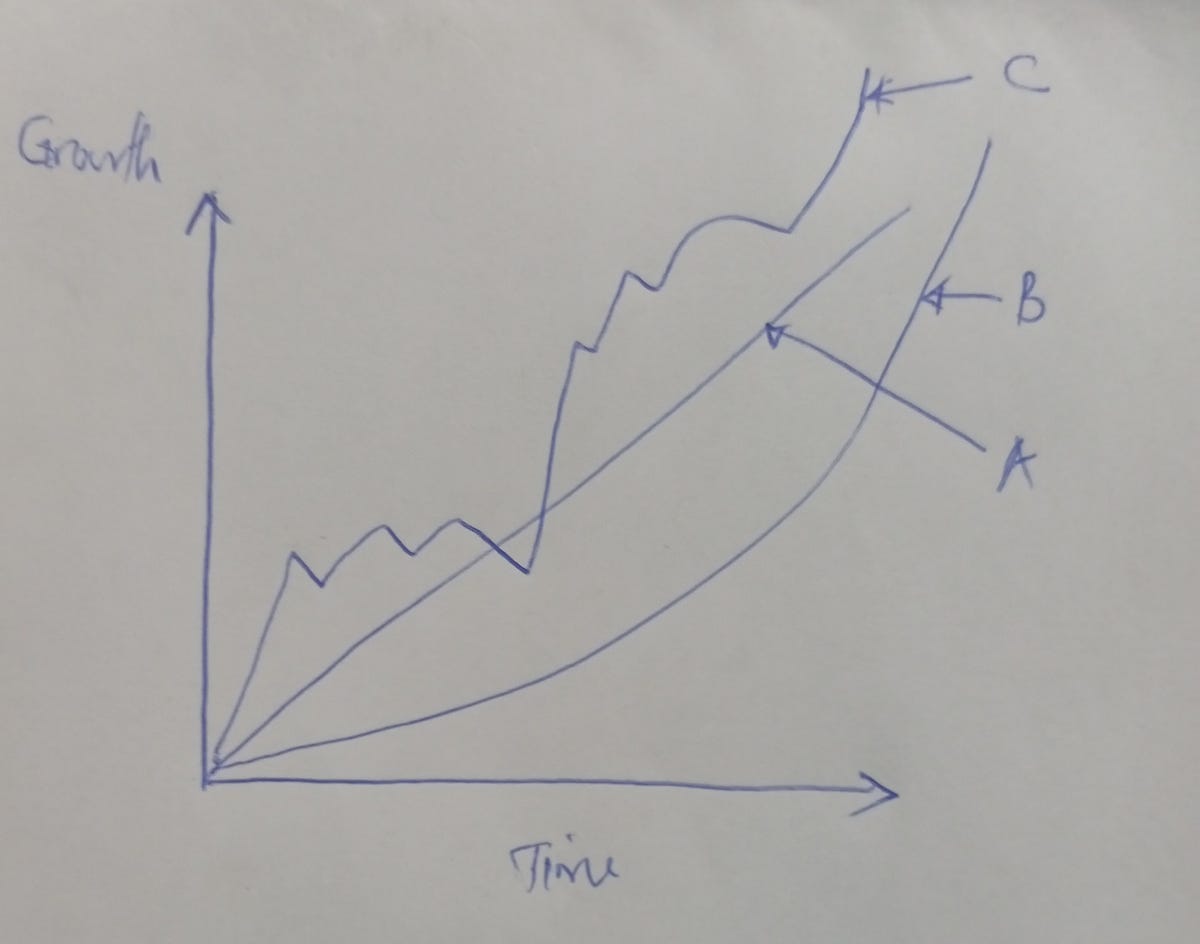
There’s also another type of growth that Einstein may have called the eighth wonder of the world: compound interest. This type of growth is much more interesting than the previous type, because it is at odds with our reptilian brains. The reptilian brain wants its rewards now, not later. Compound interest promises returns later. Patience gives this type of growth a different level of interestingness. It gets interesting because of that — patience.
Patience is also the reason why the most interesting type of growth is the plateau slope. To mine the insights, we can look at compound interest. For the most part, this growth takes a plateau-like form before it gets a rapid uptick. The best example I have ever come across is the lily pond example.
A pond has a single lily. Each day, the lilies double in number. If we had 1 today, tomorrow we’ll get two. By day 20, the pond is fully occupied with lilies. On which day was the pond half occupied? This is the part where you pause and think through your answer. I’ll share the answer at the end of this article.*
Many articles and thinkers have commented on the first phase of compound interest as the boring part. The least interesting. That for you to make money, you have to discipline yourself to weather through the most boring part of growth.
I beg to differ.
This plateau phase is the most interesting part of growth. It is the basis of writing this article.
Unpredictability
I started by citing a bug in our reasoning. Proportionality can make us slaves. That the sun was up in the morning does not mean we will have a good day. And a bad afternoon does not mean you’ll have a bad night. Our minds, however, work by extending our current experiences into the future. This is partly because our brains are predicting organs.
Predicting is the keyword. The upslope curve predicts growth matched with numbers and charts. So when an investor sees a downward spike, they wonder what could have gone wrong. It’s not interesting to watch as you lose money.
When companies make projections, usually about revenues and profits, you win and calm the sitting by showing an upward slope. Numbers defend the estimates. You assure predictability from your presentation, and clench your butt, hoping nobody asks questions when you’re done.
Predictability, however, is not interesting. That’s why the more interesting growth follows compound interest. The uptick is seen when you look back, not when it’s happening. The reason is such an uptick will still be visible even when an initial plateau phase compounds by a fixed rate. This slope, too, has a predictable feature.
The most interesting one, the one I like most, is the plateau type of growth. It confuses the brain how one can call a flat-line growth when there is no upward trajectory. This is exactly why it is interesting.
Consider a writer. They have been writing for a while with no response from an audience. Assume they have a Substack or Medium account. After a year, they only have 120 subscribers. Clicking the dashboard button hurts, sometimes, because you may never know who will drop out. Two years later, and now you have 119 subscribers. Any economist will tell you that you’re not growing.
Maybe an economist is a stretch, so let’s pick another writer. One who has multiplied their initial number will say that you’re not growing. But this concept of growth is different from the proportionality type we are used to. No upward trajectory, no growth. And yet, the compound interest curve shows why it is interesting.
You will never tell when the uptick happens, but when it does, it will be worth the wait. Patience exemplifies this plateau phase of growth. What’s more, it’s unpredictable. That is the sole reason I think this form of growth is fascinating.
As a writer, I call this phase the moat of indifference. Today you have 120 subscribers; next year, you have added only 1 or have lost three. What do you do? Do you continue swimming in this moat, or do you sink and never surface?
After writing for quite a while, you will not see the edge from where you started. The other side of the moat is also not within sight. A real plateau. On water. That you may also consider giving up is unpredictable.
However, this is the phase where growth does not reflect in numbers as in the case of the least interesting form. Growth is seen through persistence. Commitment forms by adding another data point forward, not upward. You stop to consider what happens outside and focus on what you consider more relevant now that you’re not getting any form of validation for the effort you are putting in. Unpredictable. So you create your own version of predictability.
You start to notice that you write every Saturday. You commit to write every Saturday without fail. From a chart perspective, the trajectory is forward. You have stopped thinking it will be upward. This forms the crucible or the moat.
Do you continue to swim? Do you give up and drown? Do you swim back? Does it make sense to swim back when the same journey could move you to a new shoreline?
Or do you start enjoying the swimming?
Sticking it out through the plateau phase offers an honest signal. Do you enjoy the swimming? Do you mind the indifference? Is this something you enjoy because others read or because you genuinely love writing? Would you do it forever if your subscribers continue to decay in number?
At this plateau phase, the compass of relevance shifts from the more noisy environment externally to the high-signal one internally. Consider AI. Many people think that those who are not riding the wave will be losers, but even those who are riding it will not make it to the other side. Every one of them will hit this most interesting part of growth. Those who enjoy creating what they create using AI tools will continue sailing, which adds the unpredictability of this phase — winning by not losing.
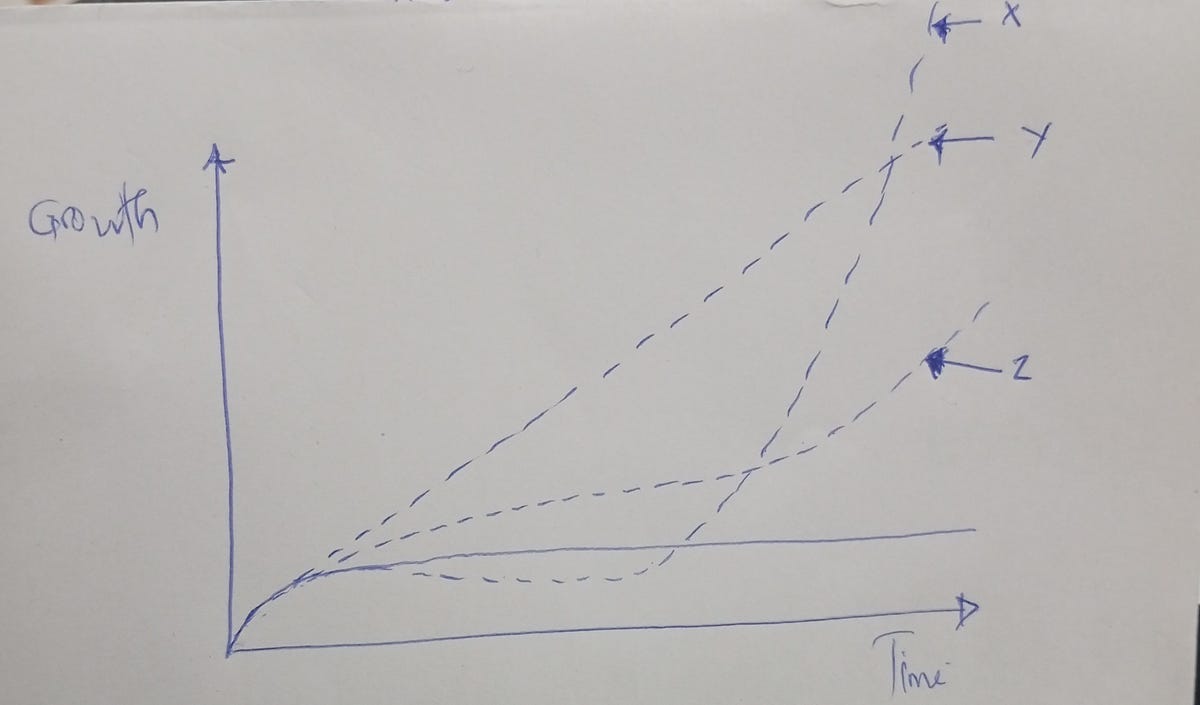
Many will give up because this moat of indifference does not appease them as they once anticipated. Our predictive organ, the brain, is not comfortable with unpredictability. Most will fall along the way. Eventually, few remain in the game. The numbers that did not stay committed usually get lost in history. Thus, the plateau phase takes on two different perspectives:
1. The ones who continued by moving forward appear to have a plateau-like chart (the unbroken line graphs)
2. They are, in essence, an upward slope because many fell along the way. (the broken line graphs)
This is one of the most interesting features of the plateau phase. When you draw it on a chart, it looks flat. However, because one person stuck it out, they leave many behind because they gave up or found something else to do. Thus, one is in essence successful, but it cannot be illustrated on a chart. There is a hidden chart, one we cannot draw but which takes shape once the one who has stuck it out in their plateau phase is compared to those who gave up along the way. Tell me that’s not interesting?
Evolution
So let’s kick
And push
And coast— Lupe Fiasco
Unpredictability is a deep-seated feature in evolution.
Take two males fighting for the attention and a chance at getting a female. Assume both of them have 10 moves on the first day. They therefore are no different from one another as far as the female is concerned.
One day, one of them decides to focus on the stage where they make their moves rather than just moving, hoping they get picked by whim. The unpredictable option of making a stage for your performance will single one out from the other. It may or may not appeal to the female, but it’s different.
It’s unpredictable in various fronts. One, we don’t know when one of the males will consider using a stage. Second, we don’t know whether the female will be amused or irked. Third, we don’t know how the other male will respond — does he mimic or does he create his own unique feature?. Fourth, we don’t know if the male in question will continue to use this new idea. Fifth, before the idea comes up, we don’t know if the female will choose one over the other on a whim. Sixth, we don’t know how long the two males are willing to fight for that attention without giving up. The unpredictability scale is insane.
Unlike the upward slope and the compound interest slope, the future at this plateau phase is unpredictable. This is exactly how mutations arise. In medicine, we don’t know when the antibiotic we have been using will mount a formidable resistance. Today, sulphur drugs are not the first-line course of malaria treatment. They were a few years back. Nowadays we use artemether-lumefantrine combinations.
One theory of evolution that showcases this example is known as punctuated equilibrium. There are moments of stasis punctuated with rapid speciation events. The interesting parts are the static parts because we cannot predict what the future will look like and how and when it will change. A speciation event is synonymous with a breakthrough, an epidemic, an innovation.
Let’s go back to the two competing males. Each has the same capabilities. So they are like the sides of a cube. Like a rolling die, you can never tell which side will come up. Thus, from a plateau phase of growth, luck comes to the fore.
Luck can be good or bad. The bad type can test one’s will. I consider a mule as an example. In evolutionary terms, it cannot reproduce. But does it die immediately? It does not. It continues to live. Stubbornly. The simile, as stubborn as a mule, is apt.
In contrast, evolutionists hardly focus on the mules. Since it cannot reproduce to give viable offspring, they are not interesting. By now, you should have already intuited I have a counterargument.
Evolution through natural selection takes the form of a rising landscape. More advanced models speak of a shifting landscape. The evolutionary landscape assumes that the most efficient species are atop a hill. Every other species tries to climb the hills. It is an objective-led kind of evolution. The goal is clear — to get to the top.
A mountain gives the picture of an ascending slope type of growth. This is the least interesting form of growth. So let’s flip the concept.
The writer who decides to continue writing has a plateau phase of growth. They refuse to stop. They avoid annihilation. That is the whole basis behind plateau slopes. And this is more interesting than the mountain/upward slope.
In the mountain slope, a single mechanism is considered that will take species to the top. Mutations are the more featured aspect. It has to be transmitted from one generation to the next because evolution, as we have always been taught, has to stretch throughout geological time. And yes, there may be interesting features we capture along the way.
But evolution by avoiding annihilation is different. The slope is that of a plateau. It is richer because it factors in elements we don’t see quite central in the mountain landscape. For instance, it starts accounting for luck. Like the rolled die. A resilient writer is one who secures themselves from the downsides of bad luck and is prepared for what happens from whatever good luck may come. What was it they say about success, preparation, and perspiration?
Other than viewing it through the plateau-slope perspective, we can also summon the concept of avoiding annihilation. Others, not traceable in history (not fossilized), were annihilated. The persistent one therefore has come ahead, alive, despite not looking like they have been improving. Sailing when others drop along the way is a version of upward slope hidden within the plateau slope. The stubborn mule. Or in the words of Lupe Fiasco, “Just a rebel in the world, with no place to go.”
For this reason, I am not an ardent supporter of evolution through natural selection because it focuses on replication and reproduction. I am a supporter of persistence, however one can. Persistence is the logical equivalent of forging ahead.
And here’s the most interesting part — there is a mountain of evidence supporting evolution through avoiding annihilation rather than through replication and reproduction.
For instance, Amazon mollies are an all-female species that have persisted despite the lethal predictions of asexual reproduction in complex species. Without the purported benefits of sexual selection, these species should have died ages ago. Theirs is persistence by forging ahead, forward, not upward. But because they forged forward, they emerged upward, beating predictions by neo-Darwinian theories. It could not be predicted, and yet, there it is. They persist to date. How is that not interesting?
Fungi imperfecti are another example, as are composite organisms. Or even the ghost plants that survive in the dark, in the absence of sunlight. These species mar the boundaries between plants and fungi, despite man’s urge to box them. They have been successful thus far by persisting.
This type of evolution is what I call Organismal Selection, to be contrasted with Natural Selection. Since hidden within the plateau slope is an upward slope, I continue to advocate that within Organismal Selection lies Natural Selection. Plus, a pinch of the unpredictable spice. It is also the reason I find it more interesting than Natural Selection.
What I’m trying to say is…
Plateaus are the most interesting forms of growth.
They have, however, gotten a tainted reputation, perhaps because the most obvious don’t typically interest us. Oxygen, clean air, electricity. We take them for granted. So they look boring.
However, the unchanging and persistent is far from boring.
To understand the universe, we should focus more on the unchanging, the plateau phases of growth.
*The pond was half full on day 19.
This song inspired some of the lines used in this article. Source — YouTube