

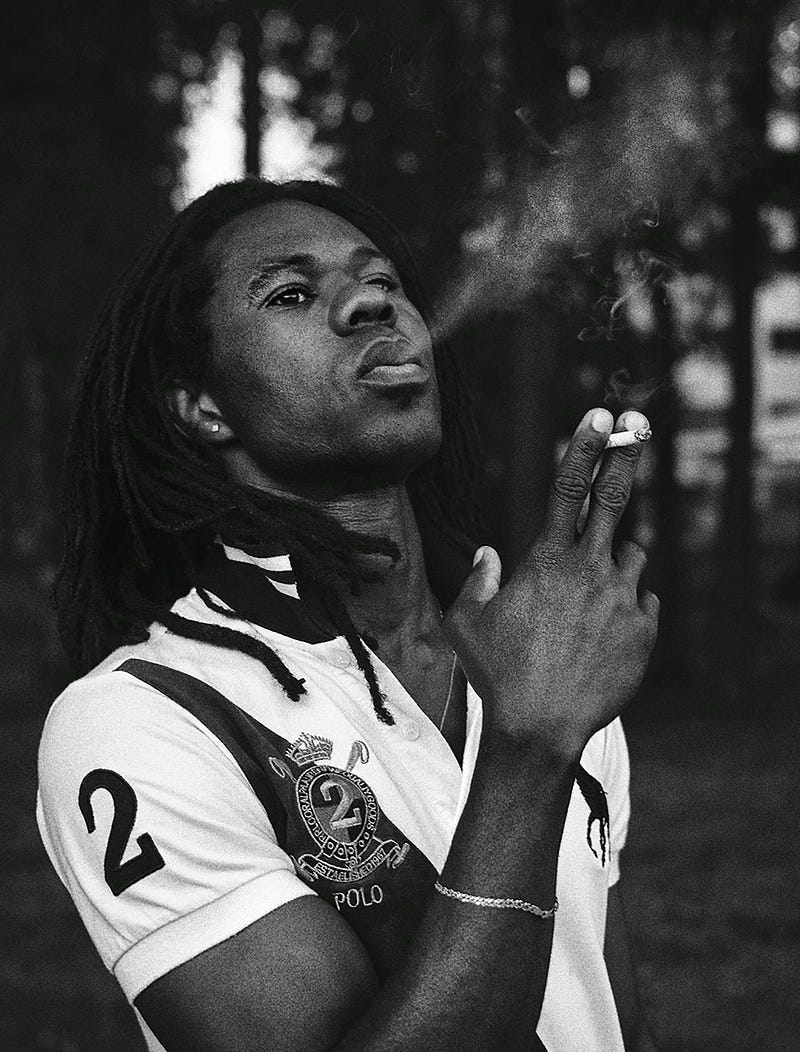
Can’t take it when you die
But you can’t live without it
— J. Cole
If you’re not busy being born, you’re busy dying.
I was once taken aback by this pithy quote, until the second law of thermodynamics told me: Hold my drink.
In truth, we’re all busy dying. This, I call the slow death. The fast death is abrupt. A bullet to the brain. A stake inside the vampire’s heart. A truck runs over you. Or, for Arsenal fans, it’s Gabriel missing a penalty. Swift. The casualty may have suffered pain only briefly, if any at all.
The relation between the slow and fast death is the reason we eat, drink, smoke, cheat, sleep, and even consume junk. This ties to our relation to death. How do we think about it? Often, it comes unannounced. We have to swallow the bitter pill that one of us is gone. For good. Once that valve closes, there’s no opening it.
However, the major difference between the slow and fast death is fear. Therein lies the clue. Consider an airplane crash. These are the worst kind for any means of travel. Before a plane crashes, all options have been exhausted. The reason has to do with checklists.
Pilots are perhaps the strongest champions of checklists. They live and die by them. As the Miracle on the Hudson revealed, without checklists, we would not be able to fly, let alone safely land on a river with zero fatalities.
But when an airplane crashes, few people ever think to use air travel the next day. Flights get cancelled. More people shift to alternative forms of transport. Road or rail. Fear controls decisions.
The 9/11 incident had most Americans fearing travel by air. The aftershock was felt in the increased number of road traffic accidents thereafter. Terrorists don’t strike once. The fear makes the rest of humanity consider alternative options which, from the most recent sequence of events, appear safer. Fear.
Fear is accompanied by fast death. It is absent in slow death. Traffic accidents are never the substance of news. Many happen. It may even be the case that the victims are rushed to the hospital and within days, all of them die, but the news channels will need to cover something during those days when they are still alive. The deaths are not fast enough to infuse fear, nor are they interesting enough to feature in primetime news. For that reason, there is less fear from travelling using the road.
So we continue to buy cars. After all, your capability as an adult is judged by various signals, like the possession of a car. Not that you can die in it, but that you own it.
What about getting a beer? Same rule book. You buy something that has the potential to kill you, but it is slow. So slow that it shouldn’t threaten you with a good time. As is the case with smoking. Weed, cigarettes, shisha. Slow death. And that pizza? There are offers every Tuesday. Terrific Tuesdays. Flavours keep on evolving. Advertisements and offers abound. These are recipes for slow death.
Slow death is never accompanied with fear, until they stick their elbows out, clawing after your heart from within. Then fear starts to kick in.
Slow death as seen inside hospitals
Proceed with caution
I heard if you chase it only results in
A hole in your heart— J. Cole
It is not uncommon to hear from patients that they have tried to control their hypertension conservatively. Indeed, it’s the first line of treatment. If you can, work out. Reduce your salt intake. Go easy on the carbs. Reduce your consumption of alcohol. Better yet, stop it altogether.
Hypertension, however, is patient. It operates at a level below your sensory threshold. Like the greatest earth bender.
Toph Beifong was born blind. Her family was royalty. She got the best teachers despite and for her blindness. However, the ones she learned from the most were badgermoles. They taught her that before landing the final blow, identify or create points of weakness. That’s how most chronic diseases operate. They weaken the redundant systems slowly such that a single trigger gets the body and families tipping into panic mode.
I see it too with diabetes. I don’t check my sugar levels. No human being in history was ever concerned with their sugar levels. We would mostly honour the hunger call, but never thought to invent a continuous glucose monitor. Why? Slow death has no fear. However, those with a different type of diabetes, noticeable from when they are young, have a different experience. To them, a brief stint with death, known as diabetic ketoacidosis (DKA), tends to make them realign their habits.
That moment when a family rushes their loved one to the hospital because they have noticed a drooping on their face is usually the signal. A late signal when tragedy has already struck. A stroke. Time, as we usually say, is tissue. The more time they take before being attended to, the more the brain tissue dies. Fear sets camp.
Complications are the most honest signals, the kind that our bodies can notice. Your heart starts pounding fast. A chest pain, crushing in character, like someone has put a heavy stone on top of your chest. A feeling of flooding in your lungs. You can’t breathe right. Fear begins to creep inside your bones. It’s infectious. It spreads to your family members.
Because slow death is far into the future, the organism, when surrounded with enough resources, will opt to make merry. Party. Debauchery. Fight. Go to war. Make babies. Build homes. Nothing like fear in these endeavours.
Why does this happen? The postponing of the threat is the symptom caused by slow death.
Systems analysis
The best way to test for the existence of an organism is to subject it to an imminent form of threat. Put a bullet inside a gun and play Russian Roulette. Watch as someone’s brain gets blown up and realize that you’re next. Given even a small chance to resist, you will.
To determine the existence of an organism, one will notice some form of resistance to an imminent, credible threat. A credible threat is the kind that can kill you. It might not register physically, but it will start coursing through your veins. Adrenaline. It’s either you fight, flee, or freeze.
In the absence of such a threat, you are free to do as you please. Eat. Sleep. Drink. Smoke. Even bungee jump.
Our senses were shaped to detect threats to our lives. Pain. A bloody scene invokes the sensation of pain the victims might have gone through. Fear, knowing you might be next. Fast death is honed into our fight or flight system.
The slow system works against our weaknesses, that is, size. A complex organism such as yourself has a much larger body than the tree shrew, the smallest mammal. You cannot tell that your blood vessels are clogging with fat that is made friable by heavy salt intake. You only know that you have eaten a heavy meal from your favourite fast food joint.
In systems, size is a buffer. The rate of change is not usually detectable compared to when one measures the change. Take weight as an example. You will not notice you have gained weight until your clothes start to feel tight or you step on a weight scale. And even when you commit to cut some of it, you won’t know how fast you are losing until you start noticing it from your clothes or on a weight scale. Our senses are not hardwired to notice rates, only stocks.
From a systems perspective, stocks are time invariant. Rates are time dependent. When you measure your weight, you pause on time to get how much you weigh. You can’t achieve that for rates, which is how much you take per given time or how much you lose for the same time. Using rates, that slow death can be fast-tracked and noticeable. But who does that?
Nobody ever died by taking a single shot of Tequila. Nobody died by taking their first puff of Mary Jane. A slice of pizza is more delicious than death-threatening. These are not noticeable by our bodies because we have no senses that pick rates. Heck, we cannot even know how many times our heart beats every so often unless we strap a smartwatch. Same goes for a continuous glucose meter. Monitoring is not in our evolutionary interest.
Our size creates a limit to how far we can enjoy. Like any buffer, resources can get depleted. Think of your blood vessels as a space that does not increase once you become an adult. Once fat deposits start to set camp on their inner surface, there is no more space to create. This space becomes depleted with time. The rate of deposit is not usually detectable.
Good fat, known as high-density lipoprotein, is supposed to mop these bad deposits from our blood vessels. Our best tests only check the stock — how much do you have now, not how fast or how slow it mops the bad fat. Stocks. Not rates. Same for the bad cholesterol. We only take the stock, not the rate. Only when we continue to visit clinics can we have a rough estimate of how the medication or lifestyle changes we have made are making an impact in our organs.
Our bodies are also not made from the substance of zebra fish. We cannot regrow our fingers once amputated. They are gone. Certain cells also have that property. The brain is a good example, as is the heart and the kidney. These are crucial organs. Once these cells go, they are gone.
What about the liver? It is a crucial organ. Most people who frequent clubs, pubs and bars know the liver can regenerate. This is one fact, but it excludes the other relevant features too — it can exhaust its buffers. You push the liver by taking alcohol, then wake up in the morning with a crazy headache, then take paracetamol, which is also metabolized in the liver, asking more of it when your body is totally spent. And because you are not keen on hydrating, and after several vomiting episodes, you’re dehydrated, your kidneys take a hit. Toxins are not clearing as fast as they otherwise should. This is not a clear signal that the buffer system is threatened, but it’s a signal you cannot ignore. So you rest.
You have always done this. It has always worked. So why not do it next time? Slow death comes with no fear. It does, however, edge you closer to the irreversible side of things.
Blindness caused by diabetes is permanent. Once it’s gone, it’s gone. Why? Because the retina detaches. These are neurons. They don’t regenerate. Or your kidneys. Once they start fibrosing, that’s it. They don’t regenerate like the liver.
The liver has some ability to mop the fibres that can accumulate, but even that is not without its limits. As it dutifully performs its role, it keeps you unaware of the size of the buffer left.
One of the best ways to think about this is your body lotion. Companies spend billions to keep their lotion containers stylish and opaque. Even perfume bottles are mostly opaque. Every time you want to make a statement, you press that nozzle, or squeeze that lotion, and by the time you’re leaving your house, you feel like you can conquer the world.
It usually hits you when the bottle is close to its end that you need to renew. That’s how the body operates. The slow death of your lotion or perfume is not noticeable. Its decay rate is opaque. When you are close to the end, that’s when it becomes apparent that there is a need for a change.
Unlike perfumes and lotions, which can be rebought, your body cannot. Slow death then morphs into the threat of fast death. Your body could self-organize and reconstitute, but after some point, it doesn’t have these capabilities. Fear sets in.
Recall that the best way to detect the existence of an organism is to subject it to imminent, credible threat. When life is at stake, we fight. Resist. But when it’s not, we relax. The doctor will give strict instructions to take the medication regularly, and you will honour them. After some time, you will feel like you’re back to your former self. Why bother with the medication? Well… slow death has curled its tentacles around you yet again.
What I’m trying to say is….
Fear is a potent motivator.
Our decisions are made with fear in mind or in its absence. For the former, it’s protective, and for the latter, it’s indulgent.
A systems perspective shows why we behave the way we do. Systems analysis also explains why Big Pharma continues to swim in money. We can’t resist the urge. And yet, the same systems perspective tells us that we can prevent these deaths.
Slow death is inevitable. How close we bring it is dependent on us.
Choose wisely.
But hey, who am I to threaten you with a good time?
This song inspired some of the lines used in this article. Source — YouTube