

Back in the day, cartoons were super creative. I would argue, more creative than the silly versions we see today.
Recently, I watched Power Puff Girls. In one episode, Bubbles was being belittled for being cutesy and cuddly, so much so that the training simulation had her difficulty level on the lower side of the scale. Buttercup and Blossom took on more difficult simulations. This stung Bubbles.
At night, when the Professor was about to close the door, the other girls requested that he leave it open so that Bubbles wouldn’t sleep in the dark, probably afraid of the Boogey Man.
That was the final straw.
That night, when the “tougher” girls were asleep, Bubbles sneaked into the simulation room and set the level to its highest one, 11. What followed were creatures that never existed in any version of our evolution in our universe. A one-eyed monster with limbs like an octopus, and a lizard fish with fans for ears, all green. The latter one rocked a costume. I’ve forgotten what the third one looked like.
I wondered: How the hell did the creators come up with such bizarre creatures?
Creativity. Imagination. As wild as it can get. Cartoons afford creators a wide latitude of imagination and a chance to create their own laws, even if they defy those of physics. In cartoons such as these, we can even have sunny nights.
We need darkness for ideas to light up our spaces
The first time I heard the song by LeRoyce, I marveled at the irony.
How can one have a sunny night?
I have grown up in Kenya. All my life. I have crossed the 30-year barrier without ever leaving the continent. My climate has the sun extending its rays throughout the year. In the temperate lands and other territories further from the tropics, there are winters and summers. Winters can have nights extending into the day, and summers can have the shine extending into timelines we would call nighttime. There indeed could be sunny nights.
But night is not so much about time, but about our surroundings. Darkness and light. From the perspective of time, we can have sunny nights. From our visual experiences, we cannot. The literal interpretation can have us settle for this conclusion.
But I began to think about cartoons. In such a world, anything goes.
Sunny nights, taken as a figure of speech, I imagined, could be no different from the lightbulb moments that cartoons effectively conveyed through their vivid imagery. Dexter, the boy genius, would have a light bulb on top of his head whenever a brilliant idea crossed his mind. We would then stay for the entire episode to watch what this new idea was. As was the case in almost every one of them, they turned out never to be that brilliant. We stayed to see how it would end, but not because the ideas were brilliant.
Most of our human life will be centered around our work. The first 16–18 years lay the foundation. The next 40+ years are spent working. After retirement, death soon follows. Literally, our world revolves around our work. It is like the sun, with its ability to curve the fabric of spacetime.
Work that has you generating ideas is the kind that has your nights lit up with possibility. I remember one time sharing a business concept with my classmates, of a restaurant that sells the usual food but with plates made from the hardened remnants of ugali, which typically stuck to the base of the saucepan. In our mother tongue, we call it “odeyo. ” Others call it “ukoko.” This hard surface could serve as a plate and dessert at the end, just like an ice cream cone, where the cone comes later, after finishing the cream.
They looked at me as if I had lost a couple of hours of sleep that week. I hadn’t. It was a “brilliant” idea, like Dexter’s, but without funding. And most of them came at night.
These ideas come when we least expect them. For adults who revolve around work, generating ideas is no different from creating your sunny nights. Why the darkness, though?
I can think of it in two ways. The first is the timing when ideas hit us, literally. I get a tonne of ideas at night. The moment I rest my head on my pillow, they start streaming, which forces me to wake up and note them down. Never lie to yourself that you will remember when you wake up. I have lost many good ideas, soaking in the hubris that I have a good memory.
These are my sunny nights.
Darkness can also be viewed as those moments when it hardly feels like there is any progress. Think about how the metaphors reflect our impressions of the future. “I see dark times ahead, ” or “Brace yourself, winter’s coming,” or even “Light at the end of the tunnel.”
Hopelessness defines the state of darkness. When a hero emerges, faces turn “bright” reflecting the glow of this unexpected saviour. Or, as Sauti Sol sang, “I know brighter days are yet to come.” A promising future is a bright future.
The contrast is necessary because darkness represents problems, and brightness represents solutions. We cannot appreciate the light without the darkness. As perennial problem solvers, we long for the sunny nights, those times when our surroundings are illuminated by our solutions.
Moments in history when there was a spring of innovation and insight were known as the Enlightenment eras. The one I like the most is the Scottish Enlightenment. Much of what has shaped our modern cultures and advancements traces its roots to the Scots.
The contrast tells something else. We need to be engulfed by darkness to develop our light. Bats did not evolve vision but echolocation. It doesn’t have to be bright for it to take the form of a solution. The opposite, being surrounded by light, gives the impression that all solutions have already been found and there is no more darkness, a false impression.
In the past, no rectangles were buzzing blue light into our retinas. Someone thought of creating the light bulb. Another thought to convert the direct current into alternating current. The darkness is there when you look hard enough, or when you simply close your eyes.
Blackouts are unanticipated. Darkness, in the same vein, can hit you unexpectedly. For Beethoven, in his early thirties, it came after his ears. One therefore has to think fast — if they want to purge it. Or if they will embrace it. Embracing darkness is not the substance of living creatures. We are problem solvers.
Always spending time on “lit” rectangles can make one forget there is a “black box” that continues to flood with mysteries unsolved, waiting for our careful poking. This is not a problem I can solely place on the current wave of online preoccupation.
Before Planck discovered that light travels in packets, his senior told him that they had discovered everything there is to discover about the universe. It would be pointless for him to pursue physics as a subject.
Planck, nevertheless, followed his curiousity. We’re grateful that he did.
At some point in human history, respected professionals once believed that all there was to know was already known. Who’s to say it cannot happen again? It may be easy to grab onto the low-hanging fruit of social media, which has a way of giving the wrong impression that everything has already been solved. As the Popperian schema reveals, one problem leads to a tentative solution, refined through error elimination, but resulting in a secondary problem. We can never run out of problems to solve.
It also means we can always have sunny nights.
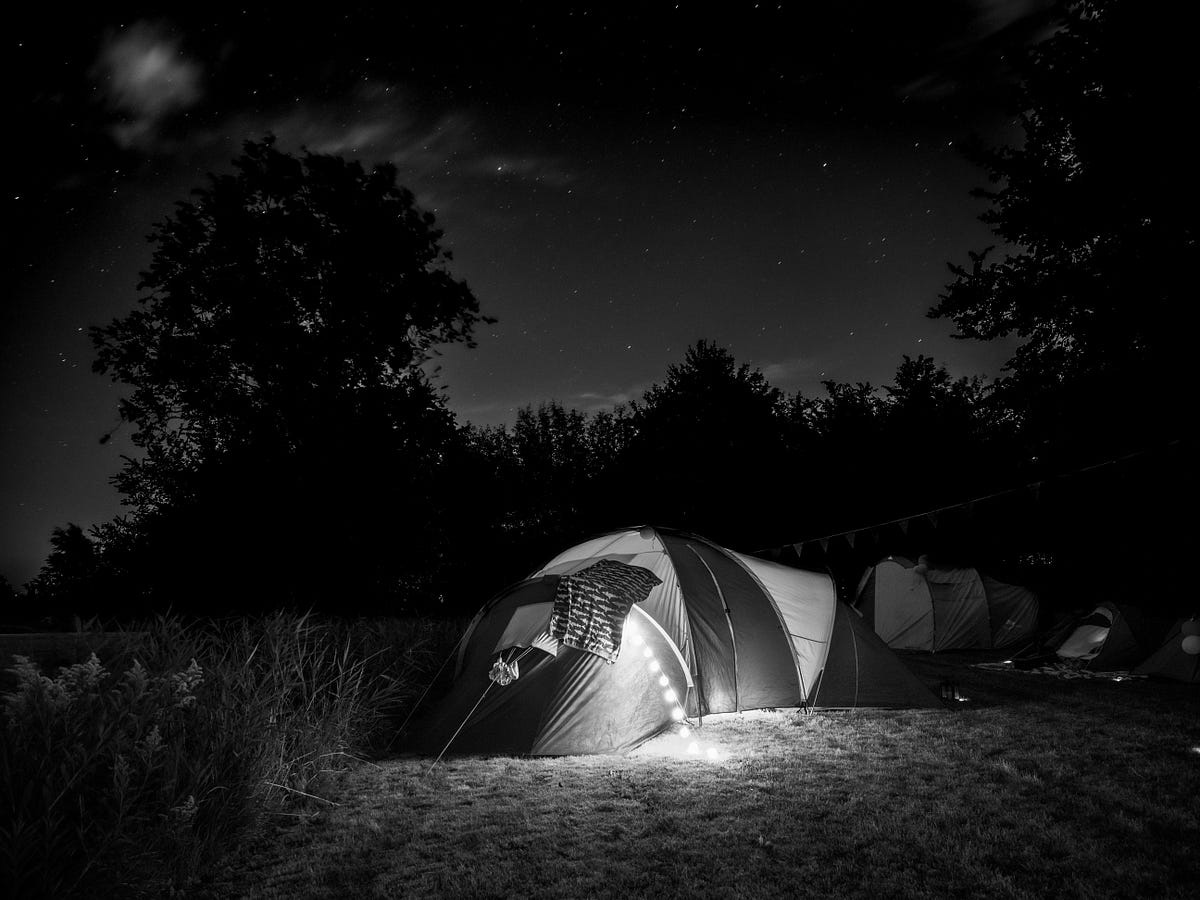
Call me nocturnal if you wish, but I think night lights have a mystique about them which the sunny days lack. Plus, when you think about it, a night sky with the moon means we’re still getting the sun’s rays, but bounced off another celestial body. The moon, in this sense, is another way of saying that the night is sunny.
What I’m trying to say is…
Sunny nights have always been with us, hidden from plain sight.
I did, however, need the help of cartoons to stretch my imagination to match reality, and appreciate that indeed, sunny nights are not an irony. They are the norm among creative folk.
We can apply the same metaphor to our work lives. Rather than embracing the dark, we can make it light up with ideas.
We should then not stop there — we should execute them.
This song inspired some of the lines used in this article. Source — YouTube