


Darwin was worried that his idea, born from decades of extensive study and rigourous mental effort, might be all for naught after he caught wind that Alfred Wallace had stumbled upon the same concept. With haste, Darwin stringed a few sentences and sent the manuscript to some figureheads in the Royal Society so that it would be known that he, too, had conceived the idea of natural selection.
In contrast, I have struggled to get an audience with some of the leading evolutionary biologists. My emails are likely landing in the spam folder or getting caught up in the middle of a swarm of others. Regardless, I have overgrown the need to get feedback and warmed up to the idea that whenever it comes, if I am still alive, I will welcome it. Until then, I’ll continue writing about the theory that I contend is superior to Darwin’s. I am also very much aware of the fact that extraordinary claims require extraordinary evidence. Such a claim must begin by distinguishing itself from Darwin’s.
My first book’s title (I say first because I intend to release another one soon) is inspired by the very weakness of Darwin’s theory. So far, I have been kind enough to show how my theory does not negate Darwin’s, but that it explains it, and more. But I risk getting lost in the pool of other written work that speaks in the same line.
I pursued molecular medicine so I could gain a voice when speaking about my ideas. I also did it because I wanted to continue diving deeper into the fields I have grown to love. The offshoot is the discovery that most of the scientists in the field have a preference for data over meaning.
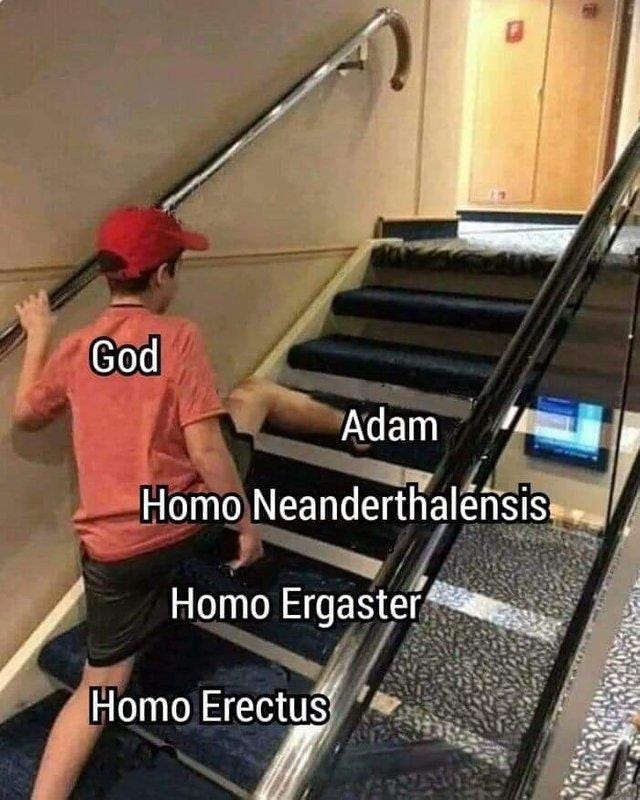
The “omics” fields search for data, hoping to derive meaning from it. An unprecedented side effect is that detail is emphasized. As long as the scientists believe they need detail, they will hardly focus on making the latticework to hang these details. It’s like the meme where one skips all the steps along a staircase to set the first foot on the fourth stair, and then develops meaning by using natural selection to explain the data. Science does not progress in this manner.
Stormzy raps:
If I had a penny or a nickel
For every time I figured it was fickle
I guess that it’s official
If I had a penny for every time data was prioritized over meaning, I would have bought a yacht.
What will one side of the data mine tell the other when several unaccounted-for valleys separate its mountains? Too much data without a guide will likely misguide.
The Human Genome Project, once completed, had its leaders jubilant that they had found the “code of human life”. In reality, they had documented a string of letters. It’s like saying you had decoded Umberto Eco by coming up with a dictionary.
The other problem with our data-seeking teams is that they take natural selection as the gospel truth. Anyone challenging the truth is either dumb, a heresiarch, or blind. History, however, reveals that all presently defended and hailed theories were once developed and supported by the “blind, dumb, heresiarchs” who proved their ideas to be valid. The massive cancel culture might be too significant to challenge the sacrosanct ideas.
Well, I guess I have to use bigger guns and more lethal ammo. In the words of Stormzy:
I’m not a hitman, I pull the trigger for free.
I’m here to pull the trigger.
First, some core differences before the core difference
I like to use the capital N and S in Natural Selection because I respect the theory. Its logic is so solid. It states that in a population or reproducing entities, there will be variants. Those with higher birth rates will succeed those with fewer. Death will come for us all. The two central ideas are reproduction and birth and death rates.
Adaptation will become a super weapon for those who harness it. Thus, adapted species are the ones most studied and praised by evolutionary biologists. Survival, however, is not simply dependent on adaptation. Luck plays a significant role. It does have a role in my theory too.
In the struggle to have more successful births than deaths, competition ensues. Will and Ariel Durant contend that cooperation is the highest level of competition among social beings. They compete as a whole unit. The antagonistic forces also need the existence of a population.
Thus, for Darwin’s ideas to prevail, it needs a population — for it to vary, for death and birth rates to occur, for competition and cooperation. From the struggles, we eventually get to the fittest. For centuries, the aphorism has stuck. Survival of the fittest. What all these ideas fail to account for is the first organism. And that’s where Darwin’s ideas part with mine.
The first organism (the title of my book) is not a population in the sense of Darwin’s theory. Neither does it merit getting into a statistician’s record because they will not know how to measure its death or birth rate. We can not even tell if the first organism had reproductive capability the moment it came into being or whether it developed it later in its life.
Who will the first organism compete with? Who will it cooperate with?
Survival of the fittest looks at the downstream effects. The latter chapters of an organism’s life. How does the idea contend with the arrival of the fittest?
All these questions can be answered by the theory of Organismal Selection, and go further to explain all the phenomena we appreciate in Darwin’s theory. It’s like a Russian doll. Nested inside Organismal Selection is Natural Selection.
But these are not what I think stand as the core difference between my idea and Darwin’s. They only whet the appetite. The biggest difference, I contend, is in agency.
Agency
Long before Darwin and Wallace, life was thought to have a designer. Many still ascribe to the belief. How else can nature be that exquisite and lack a designer?
Darwin was ruthless in his words, archived in history in his magnum opus, when he developed the dangerous idea. Order and finely designed organisms and organs can be developed through the process he outlined. Chance and nature.
Variability created the spice, and nature came with the sieve. The variation can be random, but natural selection is non-random. That’s the message Dawkins tells his readers in The Blind Watchmaker, the book that sparked my interest in evolution more than The Selfish Gene.
Agency, on the one hand, strikes biologists as odd because they know organisms to be purposive. How can the mechanism that thrives on the purposiveness lack an idea of purpose? The evidence is right there. We cannot predict the next step in evolution. That’s how the blind watchmaker operates.
Why, then, pray tell, does purposiveness persist?
Darwin’s ideas centre around variability and an unforgiving testing professor — nature. Organismic agency has little say. Nature rules. Purpose had little room in the mechanism.
The hailed concept has driven the data obsession, where details are chased because, without them, we may never know the “secrets of life”. This unilateral focus prevents anyone from injecting the agentic features of organisms into a field that believes that anyone who does so advocates for teleology or worse, intelligent design.
Here’s the irony. All biologists believe the cell to be the basic structural and functional unit of life. However, they have left it at that and narrowed their focus on the gene because, for some reason, its cryptic messages should hold the “secrets of life”. How can one leave the basic unit of life and go about seeking one of its components, thinking the answer lies there? Mindless data-seeking can create generations of scientists who might forget this crucial concept. Once they have the data, like the bed of Procustes, they fit it to the prevalent theory. The result is that the theory persists, and nobody questions it. Very unscientific in spirit.
Too much data is not good data. It needs a latticework, a frame, a theory. When details become too much, we latch onto our tools. When the data spills, everyone runs back to Darwin’s theory in the same way that firemen cling to their tools when the fire becomes unbearable.
Scientists have never known how best to develop a model that can capture the essentials of evolution and still confer agency to it. Well, I have come up with one such way. And it can be modelled. It shifts the focus of the microscope from the fine-adjustment knob (looking at the gene and the genome) to the coarse-adjustment knob (looking at the cell and the organism).
It starts by looking at the first organism and confers agency to it. Agency can be attributed to the second law of thermodynamics. But we need to be clever about it. We don’t want the high priests of the field to claim we are proponents of intelligent design or of teleology.
So rather than framing the purpose of an organism positively, we frame it negatively. The role of the organism is not necessarily to reproduce. We cannot tell if the first organism had that sole idea in mind, nor can it be supported that it existed just so that it could create its double.
The first organism desired to avoid annihilation. That is the goal of all organisms. That is the goal of all cells. I want you to notice that I have used a negative connotation: to avoid. This concept can be modelled into probability and used to logically arrive at complexity theories such as the laws of self-organization and Darwin’s ideas about selection.
It focuses on one organism. Not a population. And it gives this organism the properties we all know to reside in the cell and any other entity birthed from it.
Natural Selection is not a simple question of nature deciding who lives and who doesn’t. This is a method of adverse selection, where what is left is what nature works with. But the remnants are supposed to be good, a case of reverse adverse selection. A passive taste.
Organismal Selection, on the contrary, says that the organism fights. It resists nature’s axe swing. It can run, fly, hibernate, latch as a parasite, hide under the protective shadow of a parent, cohabitate, share genes laterally or vertically, poop the microbes into the next generation, dance to signal a new pool of nectar, extend its biological age, develop guns, live in houses, explore outer space, reproduce, and replicate its genome. The list is long. All of these can feature in the goal of “avoiding annihilation”. An active taste.
Thus, we can ascribe agency to an organism and explore all the features we know about evolution. The data then has a framework that brings together physiologists, developmental biologists, theoretical biologists, epidemiologists, and medical practitioners. I feel there are other professions I have excluded from this list, but they can list themselves somewhere in there.
And I wouldn’t want to claim that Darwin never intuited the importance of agency. He did. It’s why he stressed the struggle for existence. You cannot struggle without agency. It’s the Modern Synthesis that leaves out this important quality.
It could be an offshoot of the need to always measure. Agency could not be measured, but I have developed a means to capture this through a series of equations. A simpler version exists that matches the kind of simplicity seen in Hamilton’s inequality. I have written a three-part series to break it down. It’s simpler than the preprints.
What I’m trying to say is…
There are several differences between Natural Selection and Organismal Selection.
What I believe is the biggest difference is the attribution of agency to the basic unit of life. It does not dismiss the data accumulated from the omics, but gives them meaning from the perspective of the organism.
As Stormzy raps:
It hurts but then it tickles.
Hurts because I may be going to war, like Jon Snow, with nothing but my pectora and pen, without a dragon. The scene tickles, but somebody has to do it.
This song inspired some of the lines used in this article. Source — YouTube