

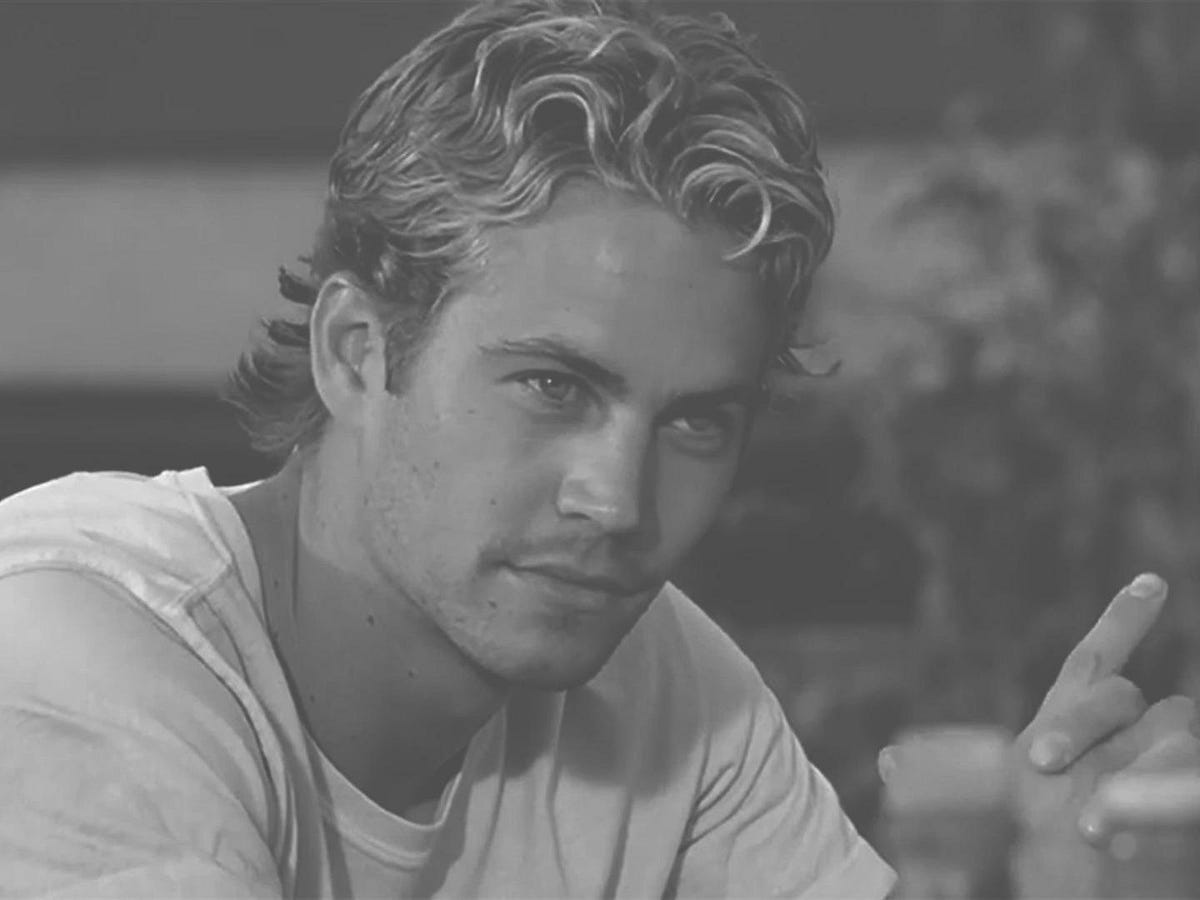
I am human. Nothing human should be alien to me
When he died, I didn’t know who everyone was talking about. WhatsApp had not introduced the statuses option. It was yet to be bought by Meta.
At the time, I wasn’t keen on knowing actor names. If you weren’t the main star, then I didn’t bother, a childhood trait that followed me to my young adulthood. After taking an interest in production, I have extended my curiousity beyond the ordinary movie or series enthusiast.
When I asked some of my friends who Paul Walker was, one movie was enough: 2 Fast, 2 Furious. As a huge Ludacris fan, notably for his eccentric videos, the name of the movie always takes me back to the song. I have the song on my phone to date. Paul Walker’s face became familiar because I had watched all of the Fast and the Furious movies. From the first to the very last one at the time.
What do you mean he’s dead?
That was my immediate reaction. Heroes are not supposed to die. Especially the ones who you get to grow with. You have seen them when they broke out and watched as they evolved in every sequel. It may not have struck home the way Raila’s death did, but heroes are not supposed to die. It’s the unwritten rule. It just is.
Typically, the actor we see is a cut version. Few make an effort to know the actor over and above the roles they are given. King Joffrey I Baratheon will always be hated by Game of Thrones fans because of how he acted, and yet, the mark of a good actor is the one who evokes the emotions their characters were meant to evoke. Few know that he also featured in the 2005 movie, Batman Begins.
In contrast, in Fast and the Furious, Paul Walker and Brian O’Conner displayed little difference. He was Vin Diesel’s (Dom’s) right-hand man. The stepbrother. The production watched him in and out of character with minimal shift in demeanor; only a switch in the name.
One of the actors would mention how he got bouts of complaints from the producer to get his act right, and when the boss left, Paul Walker would walk up to him and cheer him up, urge him to dust his shoulders, shrug it off, and take it in good stride. He was that kind of person.
Paul Walker was the guy whose death had everyone in the production team recall the day their phones were burning up with calls. Each member who got interviewed in the docuseries had nothing but positive memories of him. Admittedly, some agreed that the rush to the streets with an unsafe car at the speeds he was cruising was foolish, but they still couldn’t escape the fact that it hurt them.
Paul was the kind of actor who, after his death, the team began asking itself — should we continue filming the movie? Should we add another sequel to it? Is there going to be a replacement?
That’s when it hit me.
Your impact
How big a role have you been in your life and others’ that your death can create such ripples as the one by Paul Walker?
That is the question I asked myself.
I normally tell my girl that I don’t want to smoke weed because I know its potential effects. I don’t want to go mad before actualizing my ideas. I still feel there is a lot I have not done. It keeps me up late at night, and sometimes, filters these ambitions into my dreams when I sleep.
Will people have good things to say about you? Who will show up at your funeral? How have you touched other people’s lives? Will you live to see these people leave before you, or will you precede them? In the former case, is it enough that nobody you influenced will say how much you changed their lives will be around to see as you’re taken 6 feet under or cremated?
How can I create a standard for myself such that by the time those curtains close, I will be satisfied with the much I have done? What impact will I leave? How can I create a legacy that outlives me?
A project of one’s own, the essay by Paul Graham, always comes to mind. I bring it up because it’s an example of how an individual pours themselves into something. An idea. A creation. A concept. Realising it. Sticking with it regardless of the troubles, despite it not making economic sense, but because you believe in it. And more importantly, seeing that the project impacts lives. How does one achieve this?
I wrote about being a part of a problem as a better way to create solutions than being a part of the solution. Understanding the problem is the best way to create both temporary and sustainable solutions. Problems keep people up at night. Solutions don’t. Falling in love with your problem is enough to move you to the kind of acts that remind people that you’re human. You’re filled with meaning that is so profound, it could not be encased in you and could not be shelved after your death.
Most importantly, I asked myself — how can I create impact that is so profound that nobody can ever think of replacing me?
The crew at the Fast and the Furious knew, without question, that they can never replace O’Conner. They could never replace Paul Walker. As he died before Fast 7 was completed, the team had to find a way to give him a decent send-off.
Who steps up? His brother. He fills the driver’s seat in the car that we see at the end of the movie, where Dom and O’Conner part ways at the fork of the road.
The team began compiling all the words Paul had uttered in the previous films to create a realistic version of the words they would string together in that final scene. They then assembled the most advanced tech to replace his brother’s face with his, and merge it all together. That time when the crew sat down to watch the movie, at the end, they did not turn on the lights. Everyone was in tears. Try as much as they did, they could not replace Paul Walker.
So I continue to ask myself — how valuable is my contribution? At work, I know I am replaceable. But even if I leave, will my impact be felt? If not, how can I change that?
Some people may say that doctors are already saving lives, but most people don’t know that doctors are haunted by those they didn’t save. How can they avoid preventable deaths? How can they do better? How can they ensure that their years of experience are passed down to the next generation of medics?
That final scene of the movie reminds me of AI. Many companies bring up the fear that AI will replace many people. It already has started. The challenge I would pose to others, as I do to myself, is how weak is my contribution for it to be taken away with a single email? How can I change that? How can I enjoy doing that work without it feeling like a burden to myself? Most importantly, how can I be irreplaceable like Paul Walker?
My supervisor used to tell me: Innocent, become so important that the world cannot dare to ignore you. It’s difficult to be that important, but not impossible. And the world he was referring to doesn’t have to be the third planet in the Solar System. It can be a small group. Family, sometimes, as the Fast and Furious franchise showed.
My mother likely never saw any of Paul Walker’s movies. But she knows the importance of being there for family. The other day, I wanted to take her to watch Michael. She was the one who introduced us to Michael Jackson. I can’t think of anyone bigger a fan than her in my circle. I had to take her. It saddened me that she came late and that I had to leave the theatre to get her. But as I saw her face, my grief melted away, and I couldn’t do anything but smile.
Her first words were, “You asked that I come, and I had to come, no matter what.” How can you get mad at her with those words? She knows the power of family and the simple act of showing up. These moments are irreplaceable. These are the memories we remember. These are the instances that cannot be replaced by AI.
Maya Angelou’s words come to mind: I am human. Nothing human should be alien to me. AI is taking over so much of our actions that it can make anyone question what it is to be human. Social media has already distanced genuine human interaction. The name is an oxymoron, because there is nothing social about today’s social media. This is one of the reasons I’m so keen on growing the festival I started, to foster genuine human connection.
At the time of this writing, my current read was E. O. Wilson’s Biophilia.
I picked many books along the way and pushed this one aside for reasons I cannot tell. Like Thanos’ proud statement after the Avengers came back to fight him, my reading escapades brought me back to the book.
In particular, I had broken the name into two parts. “Philia” to mean attraction, and “bios,” which means life. He makes the argument that we are so drawn to living things that we cannot help ourselves.
AI can be repulsive and continues to get attacked, likely because it has little to show that it is like us besides intelligent stochastic parroting. Other applications, such as Claude Code, have really shaken the programming world. But others, which sometimes is substituted for therapy, appeal because social media has created a loneliness that makes anything that mildly resembles genuine connection worth the while.
It nevertheless behoves us to question our lives thus far and challenge ourselves: What impact have I made that is irreplaceable? How can I leave an impact that is as profound as Paul Walker’s?
These acts are what Adam Mastroianni would consider to fit inside the good cup. The good cup contents don’t evaporate fast. They take their time. The bad ones do. So we forget more about them. The good ones last longer. Thus, they tend to align closer with the non-linear compounding curve than the linear one. As we stop to improve the lives of others, the good cup evaporates. However, the more we add to it, the more it compounds, faster than its evaporation rate.
That, I believe, is how we can become irreplaceable.
What I’m trying to say is…
We all can make a meaningful impact. Stripped of the previous biases and stereotypes, every human being can make a positive contribution. It generally means we can leave the world better than how we found it. Each with their irreplaceable, irreducible impact.
Tyrese Gibson had this to say:
Universal knew it. They were the first ones that had the balls to jump out there and actually have a movie poster that represented it. Hollywood literally took black people off of movie posters when they started promoting these films overseas. And why? Black people don’t translate into box office success overseas. And that is a narrative that has been around for almost a 100 years, and The Fast and the Furious changed that. And we may not ever win a Oscar, but Hollywood has been changed forever. The Fast and the Furious, the franchise, gets the credit.
I’m certain Paul Walker would agree.
This song inspired some of the lines used in this article. Source — YouTube